Nvidia Develops Safety Controls as AI Advances Into Robotics
Figure, Gecko Robotics and Skild AI are working with Nvidia's new agent-control technology as investment pours into computing designed to push up physical machines’ autonomy.

October 1, 2026 by Artem
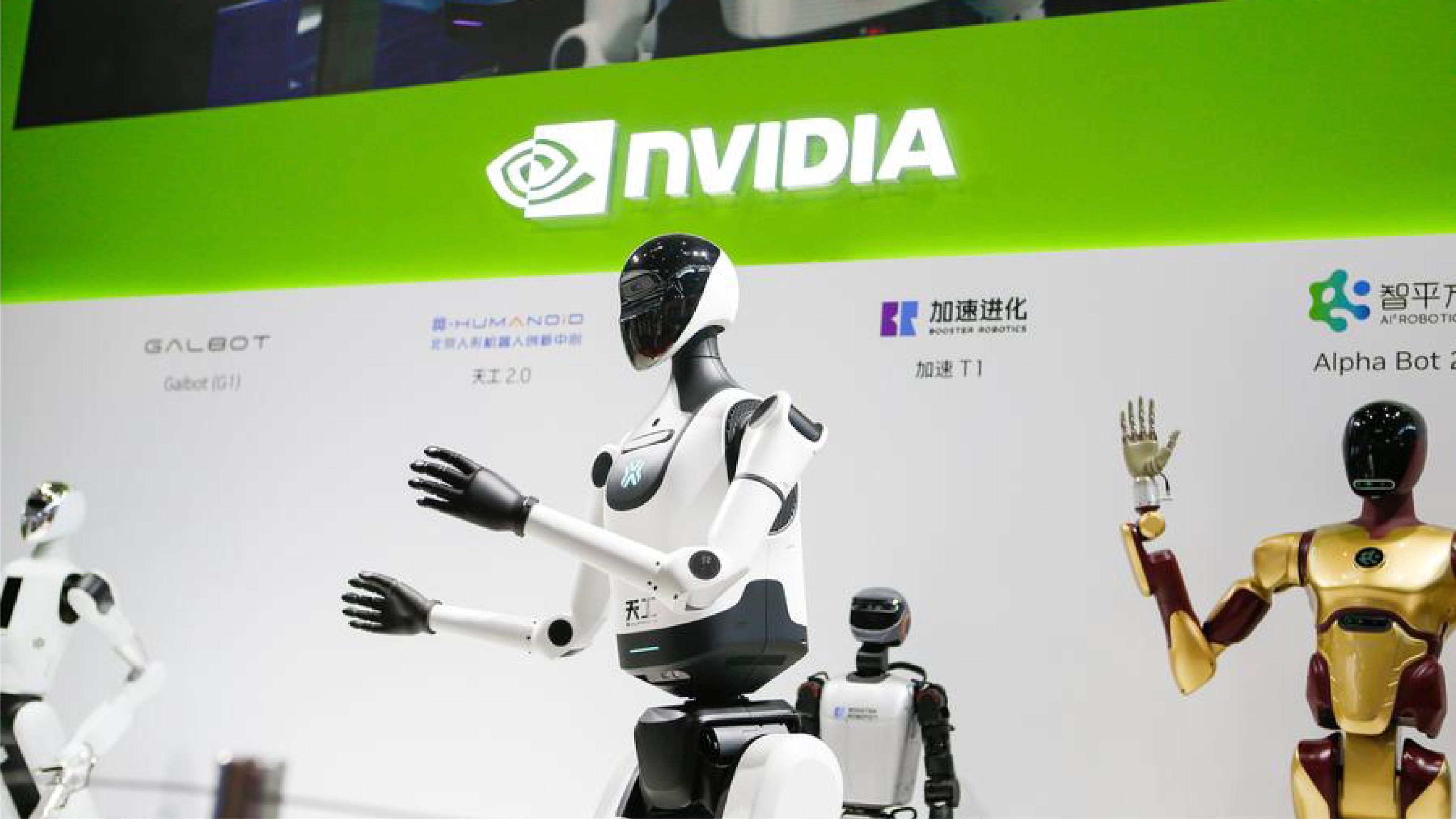
SANTA CLARA, Calif. — Nvidia is extending its AI business into another layer of robotics: controlling what increasingly autonomous systems are allowed to do.
The chipmaker introduced its Open Agent Safety Platform, an architecture that places boundaries on AI agents. Nvidia says those controls can extend through software, computing hardware and robots executing tasks in the physical world.
The system composed of OpenShell, open-source software that puts an agent in a restricted runtime environment, with Sentry, an optional hardware-level watchdog running on Nvidia's BlueField-4 data processing units.
OpenShell can set restrictions on agent access. Sentry, a separate system, independently monitors activity and can quarantine an agent that attempts to move outside those boundaries, according to Nvidia.
That framework is now extending to robots. Nvidia named Figure, Gecko Robotics and Skild AI among robotics companies building with OpenShell.
Gecko illustrates most clearly what has the potential to happen beyond the confines of a data center. The company tested OpenShell on a live inspection robot at its Pittsburgh facility.
In one test, the software monitored movement commands and blocked commands that would move the robot outside its operating area. Gecko also configured the system to halt the robot when someone crossed a safety zone. The company says OpenShell can require human approval before an AI agent changes parameters such as inspection speed. The system has not reached production.
The approach does not replace conventional robot safety. Industrial robots remain subject to machine-level risk-reduction requirements covering their design and integration, including the ISO 10218 standards. Nvidia's technology instead focuses on risks when AI agents control robots.
Nor does the platform solve every problem with autonomous AI. Somesh Jha, a University of Wisconsin computer science professor, told The Associated Press that restrictive controls may hinder useful agent behavior. He added that real-world trials are needed to find the right balance between functionality and security. The AP noted that Nvidia's system cannot by itself prevent models from making mistakes or behaving deceptively.
MORE COMPUTE MOVES INTO MACHINES
Investors are now funding a different layer of the physical‑AI stack — edge compute that can run more complex models directly on devices.
SiMa.ai raised $150 million in Series C financing, valuing the semiconductor company at $1.45 billion and bringing its total capital raised to $500 million. Fidelity Management & Research Co. and Amplify co-led the round.
The money is not exclusively for robotics. SiMa.ai said the financing will support robotics as well as other edge uses such as industrial automation and smart cameras.
Its planned physical AI hardware aims to achieve 1,000 tera operations per second (TOPS) with production chiplets and systems-on-chip expected in the first half of 2028. Those specifications and timing remain the company’s targets.
The two announcements concern different businesses but converge on the same technical inflection point. Companies are putting more computing at the edge so robots can perceive conditions, make decisions and act locally. Nvidia is simultaneously building infrastructure designed to physically restrict actions before they become physical actions.
For companies buying autonomous robots, that could make the computing stack do more than run models; operators can limit model behavior. It may also become one of the places where model operators set limits on.
Nvidia's controls are available now, but their use in robotics is still in its infancy. Gecko's implementation is still a pilot, while Nvidia reported no disclosed production deployments of OpenShell at Figure or Skild AI.
More articles on this topic
12 articles ReportOctopus-Inspired Muscle Design Simplifies Dexterous Soft Robots
 Report5 Jobs Robots Could Take Over by 2035 — And 5 They’ll Struggle to Replace
 ReportBoston Dynamics Sacrifices Atlas’ Fifth Finger for Efficiency
 ReportAgility Adds FORT Safety Infrastructure to Digit 5
 ReportEni, Generative Bionics Partner on Industrial Humanoid Robotics
 ReportFeather Prices Modular Dual-Arm Robot at $29,990
 ReportSamsung Plans Factory-First Path for Humanoids Before Home Robots
 ReportDyna Launches Wheeled Semi-Humanoid for Full Workflows
 ReportWhy aren't robots in our homes yet?
 ReportRobotera Says Dexterous Hands, Not Walking, Are Humanoids’ Bigger Challenge
 ReportFlourish Opens Preorders for $3,555 Trainable Home Robot
 ReportSiMa.ai Raises $150 Million to Scale Chips for Humanoids, Physical AI
BUSINESS NEWS WEEKLY LETTER
The Weekly Letter for Robotics Professionals, Summarizing the Most Important Industry Moves, Launches, Deals and Signals.