Why aren't robots in our homes yet?
Humanoid robots, built to mirror the human body, still lack physical attributes to match their artificial intelligence.
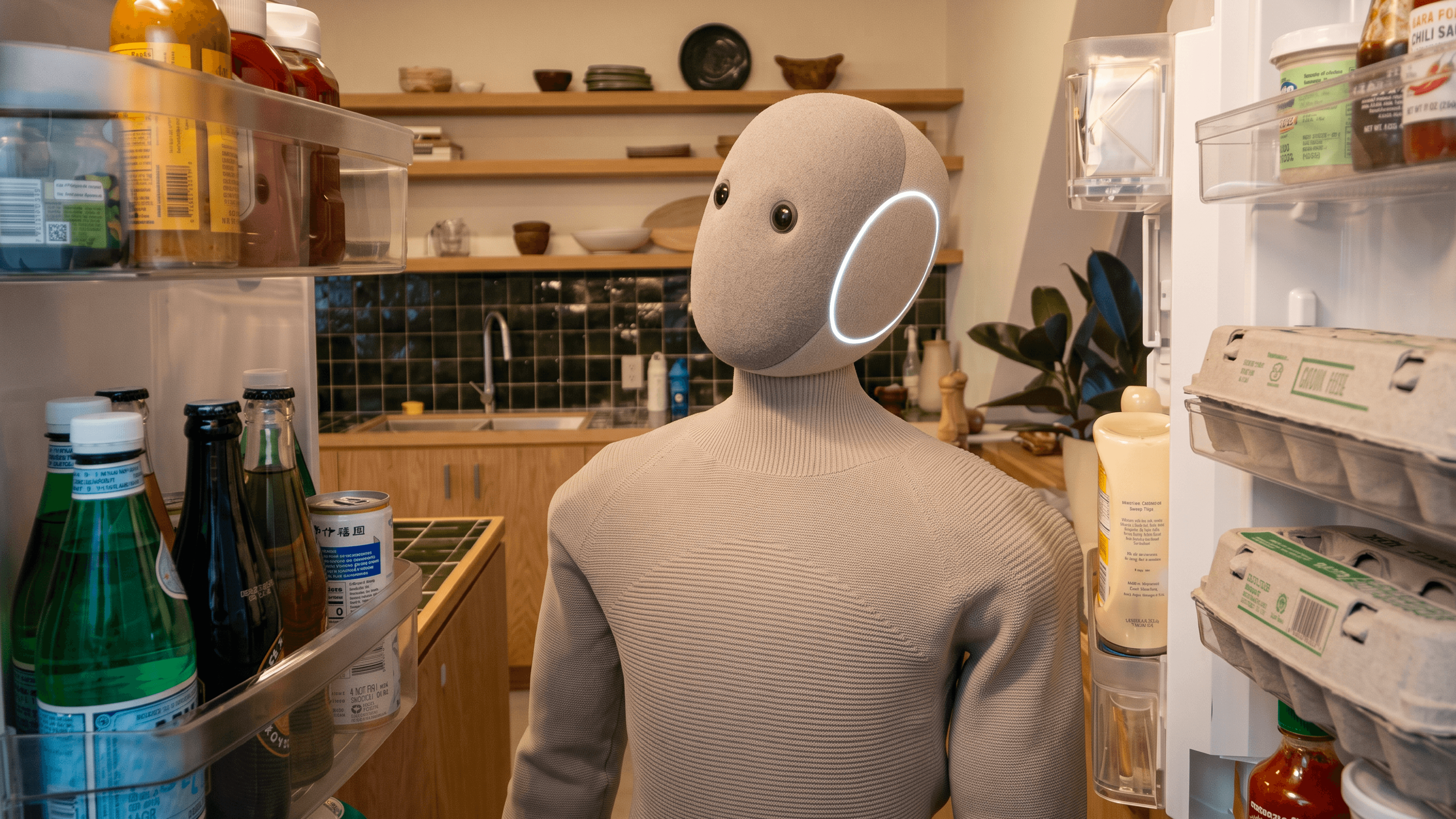
Science fiction promised us robots that unload the dishwasher, fold the laundry, tidy up and keep track of the grocery list. It's easy to assume the technology has finally caught up. It hasn't.
Movies like "Big Hero 6" shaped our sense of what robots can do. Now that AI has advanced so far, it's worth asking where physical intelligence actually stands in the real world.
Why factories are the easy case
If robots are already common in factories, why can't they work in homes? The answer comes down to environment. A factory is controlled. A home is uncontrolled and constantly changing.
In a factory, everything is fixed, from the lighting and flooring to the number of people on the floor at any moment. Even small variations can cause many robots to fail. Machines are bolted in place, and tasks repeat the same way every time. Robots train in that same space, and the data compounds over thousands of repetitions until the robot can perform one precise motion again and again. It can't stray far from that task.
Consider a robotic arm built to lift a car door and hold it steady while workers and other equipment attach it at the hinge. That's all it does. Day after day, its only job is to hold the door in place.
Why a home breaks that model
To see what changes in an uncontrolled environment like a home, consider how a robot perceives space.
Start with lighting. In a home, it shifts throughout the day, from bright morning sun to a dim evening lamp. Robots rely on cameras to make sense of a room, so a change in lighting can transform how they see it. People and pets moving through the space also make it harder to tell fixed objects from moving ones.
A loose rug is a footing problem: The robot must recognize that the ground is unstable and adjust its balance in real time, something a factory floor never demands. A stray toy is a judgment problem: The robot has to decide whether it's safe to nudge, whether it belongs to a child and whether it might break. That categorization must happen first. In a factory, by contrast, every part is known in advance, and the robot practices a set task.
A fragile object like a glass is a grip-and-force problem. The robot must gauge how much pressure to apply and adjust mid-grip if it senses the object deforming. If it lifts a bottle and feels it losing shape, for example, it needs to recognize that the bottle is plastic and ease its grip.
Laundry may be the hardest challenge of all. A cup or a tool holds its shape and behaves predictably, but fabric twists, folds over on itself and looks different every time and from every angle. About a decade ago, researchers at the University of California, Berkeley, spent years teaching a robot named BRETT to fold towels. At first, it poked at a pile of towels searching for a corner to grab, unable to tell where one item ended and the next began. Even after the team cracked the problem, BRETT needed 20 minutes to fold a single towel.
MIT roboticist Daniela Rus has tackled the grip side of the problem by building a soft robotic arm with spongy skin that can wrap around objects and apply just the right pressure. "A soft appendage can adapt to the surface and grasp better," she told The Wall Street Journal.
Another workaround is to put a person in charge. In 2019, Japanese startup Mira Robotics unveiled Ugo, a rental robot that could pull laundry from a machine and fold it, but a human operator remotely controlled its arms for the hard parts.
What's actually out there right now
At CES 2026, an Nvidia press release quoted CEO Jensen Huang as saying, "The ChatGPT moment for robotics is here." Onstage, Huang was more measured, saying that moment for physical AI was "nearly here."
So how close are working humanoids to our homes?
1X's home robot, Neo, costs $20,000, or $499 a month by subscription. The company began full production at a factory in Hayward, California, in April 2026, but the first units went to internal research and home testing. As of mid-July, no customer delivery had been independently verified, and 1X has said some buyers will get their robots this year and some later. For chores Neo can't yet handle alone, 1X relies on Expert Mode, in which a human wearing a virtual reality headset remotely steers the robot through its cameras. 1X says privacy protections include no-go zones the robot can't enter and blurring of faces it sees.
Weave Robotics shows a middle path. Its stationary Isaac 0, which began shipping to California homes and businesses in February 2026, folds a pile of laundry in 30 to 90 minutes. It handles shirts and shorts on its own, while a remote operator takes over for trousers and underwear. Its mobile successor, Isaac 1, is designed to make beds, clear clutter and fold and put away clothes. It works on its own by default, with a human stepping in remotely when needed. Isaac 1 costs $7,999, or $449 a month, with California deliveries starting this fall.
Many home robots marketed as smart still lean on a hidden human. The real measure of progress is how often that human has to step in.
The real reason: Moravec's paradox
In his 1988 book "Mind Children," robotics researcher Hans Moravec wrote that "it is comparatively easy to make computers exhibit adult level performance on intelligence tests or playing checkers, and difficult or impossible to give them the skills of a one-year-old when it comes to perception and mobility."
In other words, it's easier to build a computer that beats a chess master than one that can safely pick a sock up off the floor and put it in the right drawer. High-level skills such as reasoning, planning and playing games are the easier part for a machine because they can be processed as data. Physical skills such as balance, grip and coordination are genuinely harder, even though a 1-year-old does them without thinking. They require a machine to replicate what the human body does.
This flips most people's intuition. We tend to assume that anything closer to human intelligence must be harder to build than something physical. The reverse is true: Reasoning is far easier to copy than physical intelligence. Unrolling a rug, picking up a toy or sorting a pile of laundry are 1-year-old skills for a human. For a robot, they're the very skills that leave it helpless.
So when will it actually happen?
In September 2025, roboticist Benjie Holson of Robust AI posted a set of escalating physical tests for humanoid robots, calling them the Humanoid Olympic Games. He expected the hardest events to take a year or more. Instead, within about three months, a robot from San Francisco-based Physical Intelligence completed 11 of the 15 tasks, including washing windows and spreading peanut butter.
"I used to think home robots were at least 15 years away," Holson told Scientific American. "Now I think at least six."
Holson also cautioned that a lab demo is a long way from a product you can buy, pointing out that Waymo's cars were driving on roads years before anyone could pay for a ride. No one in the industry yet knows exactly what it will take for a single humanoid to unload a dishwasher, sort laundry and write a grocery list. Still, the momentum is real, and it's building faster than expected.
More articles on this topic
156 articles ReportOctopus-Inspired Muscle Design Simplifies Dexterous Soft Robots
 Report5 Jobs Robots Could Take Over by 2035 — And 5 They’ll Struggle to Replace
 ReportNvidia Develops Safety Controls as AI Advances Into Robotics
 ReportFlourish Opens Preorders for $3,555 Trainable Home Robot
 ReportHow Do Robots See the World?
 Report6 Unusual Jobs Done By Robots
 ReportRLWRLD Expands Physical AI Push for Industrial Robots
 ReportCircus SE Partners With Royal Prestige for UAE Food-Robot Launch
 ReportSix Giant Robots from Around the World
 ReportThree Real Robots Inspired by Star Wars
 ReportJobs You Didn't Know Were Done by Robot Dogs
 ReportBatteries Included: Why Staying Powered is Hard for Robots
BUSINESS NEWS WEEKLY LETTER
The Weekly Letter for Robotics Professionals, Summarizing the Most Important Industry Moves, Launches, Deals and Signals.