AGIBOT A2 vs. Unitree G1
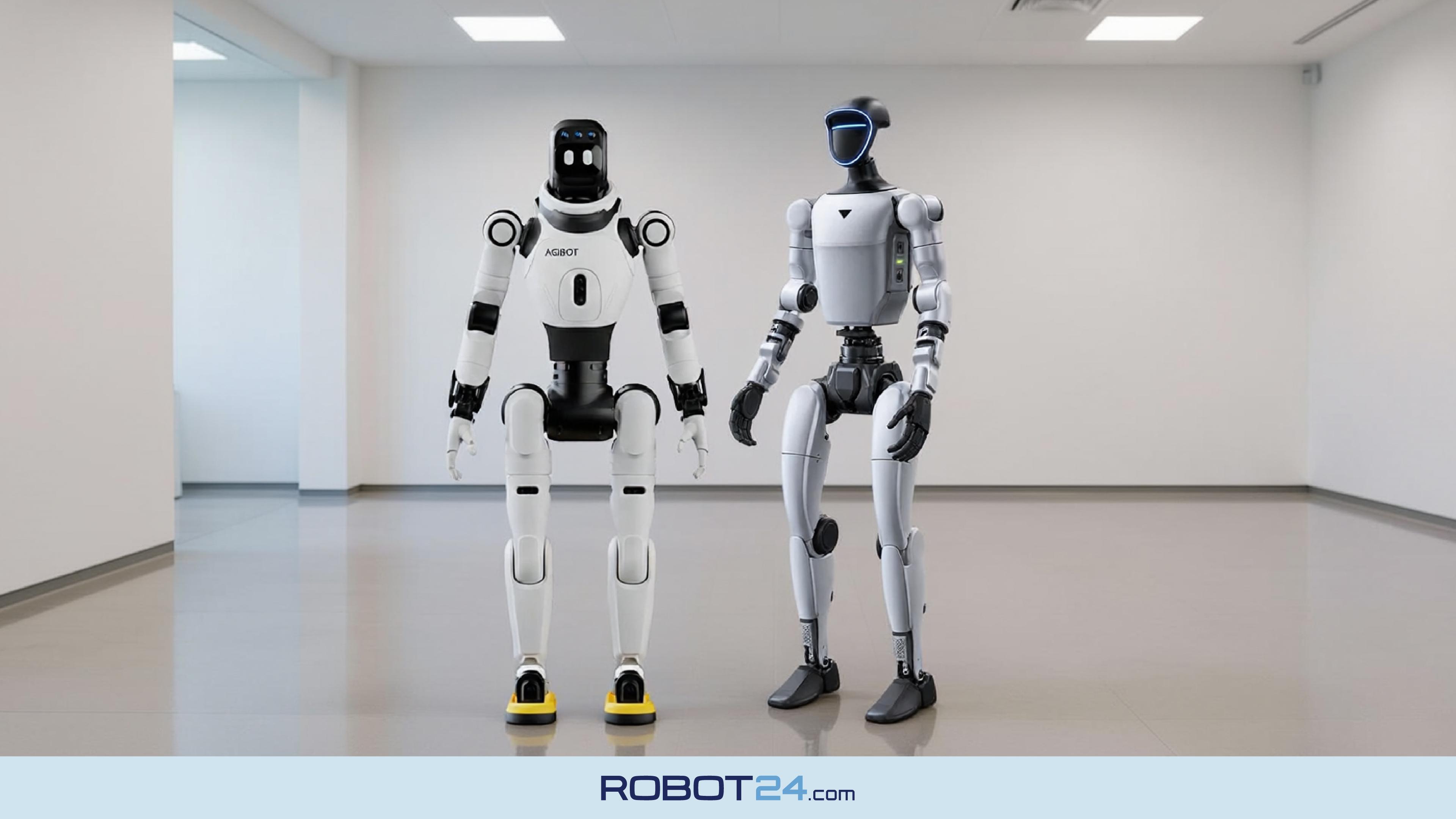
The AGIBOT A2 and Unitree G1 are both Chinese bipedal humanoids with LiDAR and about two hours of runtime, but they serve different markets. The 170 cm, 60 kg A2 targets customer-facing and industrial work, while the compact 127 cm, 35 kg G1 is a lower-cost platform for research and education.

November 20, 2026 by Business Desk Team
Introduction
The AGIBOT A2 and the Unitree G1 are two Chinese-made bipedal humanoid robots. Both walk on two legs, use LiDAR for perception, carry a microphone array, adapt to uneven terrain and run for about two hours per charge.
The primary distinction lies in their size and purpose. The A2 is a full-size humanoid at 170 cm and 60 kg, aimed at retail and showroom operations, hospitality, and manufacturing and industrial work. The G1 is a compact humanoid at 127 cm and 35 kg, aimed at research and development, education and training, and industrial and AI development.
The available specifications also vary in detail. The G1 has a named LiDAR unit (the Livox MID360 3D LiDAR) and listed connectivity of Wi-Fi 6 and Bluetooth 5.2, while connectivity for the A2 is not recorded. The A2, in turn, has a listed 700 Wh swappable battery and a higher range of degrees of freedom.
This comparison is based on ROBOT24.com market-data records for both robots.
At a Glance
| Metric | AGIBOT A2 | Unitree G1 |
|---|---|---|
| Mobility type | Bipedal humanoid | Humanoid |
| Locomotion | Walking | Bipedal |
| Typical use | Retail & showroom operations; hospitality; manufacturing & industrial operations | Research & development; education & training; industrial & AI development |
| Height | 170 cm | 127 cm |
| Weight | 60 kg | 35 kg |
| Walking speed | 3.5 km/h | 2 m/s |
| Degrees of freedom | 40–49+ | 23–43 |
| Battery | 700 Wh swappable battery | 9,000 mAh |
| Runtime | ~2 hours | ~2 hours |
| LiDAR | Yes | Livox MID360 3D LiDAR |
| Microphone array | Yes | Yes (EDU versions) |
| Connectivity | Not recorded | Wi-Fi 6; Bluetooth 5.2 |
| Terrain adaptation | Yes | Yes |
| Price in Robot24 record | Approx. $27,000–100,000+ | Starting at $13,500 |
| Nationality | Chinese | Chinese |
| Availability | Prototype | Commercially available |
| Status | Commercial | Commercial |
Source: ROBOT24.com market-data records.
How They Compare
Both robots are bipedal humanoids equipped with perception systems and designed to navigate human environments. However, they differ significantly in size, mobility, articulation and commercial positioning.
The A2 is the larger robot. At approximately 169 cm and 69 kg, its human-scale design is suited to face-to-face interactions in retail stores, showrooms and hospitality environments. The G1 stands 132 cm tall and weighs approximately 35 kg, making it a more compact platform for laboratories, classrooms and robotics development.
The G1 has the higher recorded walking speed. Its listed speed of approximately 2 m/s equals 7.2 km/h, compared with the A2 Ultra's maximum of 1.2 m/s, or 4.32 km/h. However, maximum speed does not establish better mobility or stability under real-world operating conditions.
Articulation also differs by configuration. AGIBOT lists 40 active degrees of freedom for the A2 flagship, while Unitree lists 23 for the standard G1 and up to 43 for EDU versions. This means some G1 configurations offer more degrees of freedom than the A2 flagship. Greater articulation can support more complex movements, although actual manipulation performance also depends on control systems and hardware design.
The robots use different battery specifications. The A2 flagship has a 700 Wh swappable battery, while the G1 uses a 9,000 mAh quick-release battery. Because the figures use different units, their energy capacities cannot be compared directly without the G1's battery voltage. Both manufacturers list approximately two hours of runtime, although endurance varies with the task and operating conditions.
Both robots support LiDAR-based perception. The G1 has a 3D LiDAR system and supports Wi-Fi 6 and Bluetooth 5.2. AGIBOT's A2 Ultra supports Wi-Fi and 4G/5G connectivity. Both manufacturers also list microphone arrays, although the exact sensor and interaction configurations depend on the model.
Pricing is another important distinction. Unitree advertises the standard G1 from $13,500, excluding taxes and shipping. ROBOT24.com records indicate an approximate A2 price range of $27,000–$100,000+, depending on configuration, although current quotations require confirmation.
Unlike the earlier prototype classification, AGIBOT now commercially markets the A2 through its product and sales channels. The G1 is also commercially available, with EDU configurations and certain features subject to separate purchasing arrangements.
More articles on this topic
170 articles ReportRichtech DUST-E S vs. Gausium Phantas
 ReportEngineAI SE01 vs. AGIBOT RAISE A1ReportRichtech DUST-E S vs. KEENON KLEENBOT C20
 ReportAGIBOT G2 vs. KEENON XMAN-F1
 ReportOrionStar GreetingBot Mini vs. KEENON GUIDERBOT G2
 ReportPUDU FlashBot vs. KEENON DINERBOT T3
 ReportPUDU CC1 Pro vs. KEENON KLEENBOT C40
 ReportPUDU ET1 vs. KEENON KLEENBOT C20
 ReportUniRing MAX vs. KEENON KLEENBOT C40
 ReportAGIBOT X2 vs. Unitree R1
 ReportPUDU CC1 vs. UniRing MAX
 ReportPUDU KettyBot vs. KEENON DINERBOT T8
BUSINESS NEWS WEEKLY LETTER
The Weekly Letter for Robotics Professionals, Summarizing the Most Important Industry Moves, Launches, Deals and Signals.