OrionStar GreetingBot Mini vs. KEENON GUIDERBOT G2
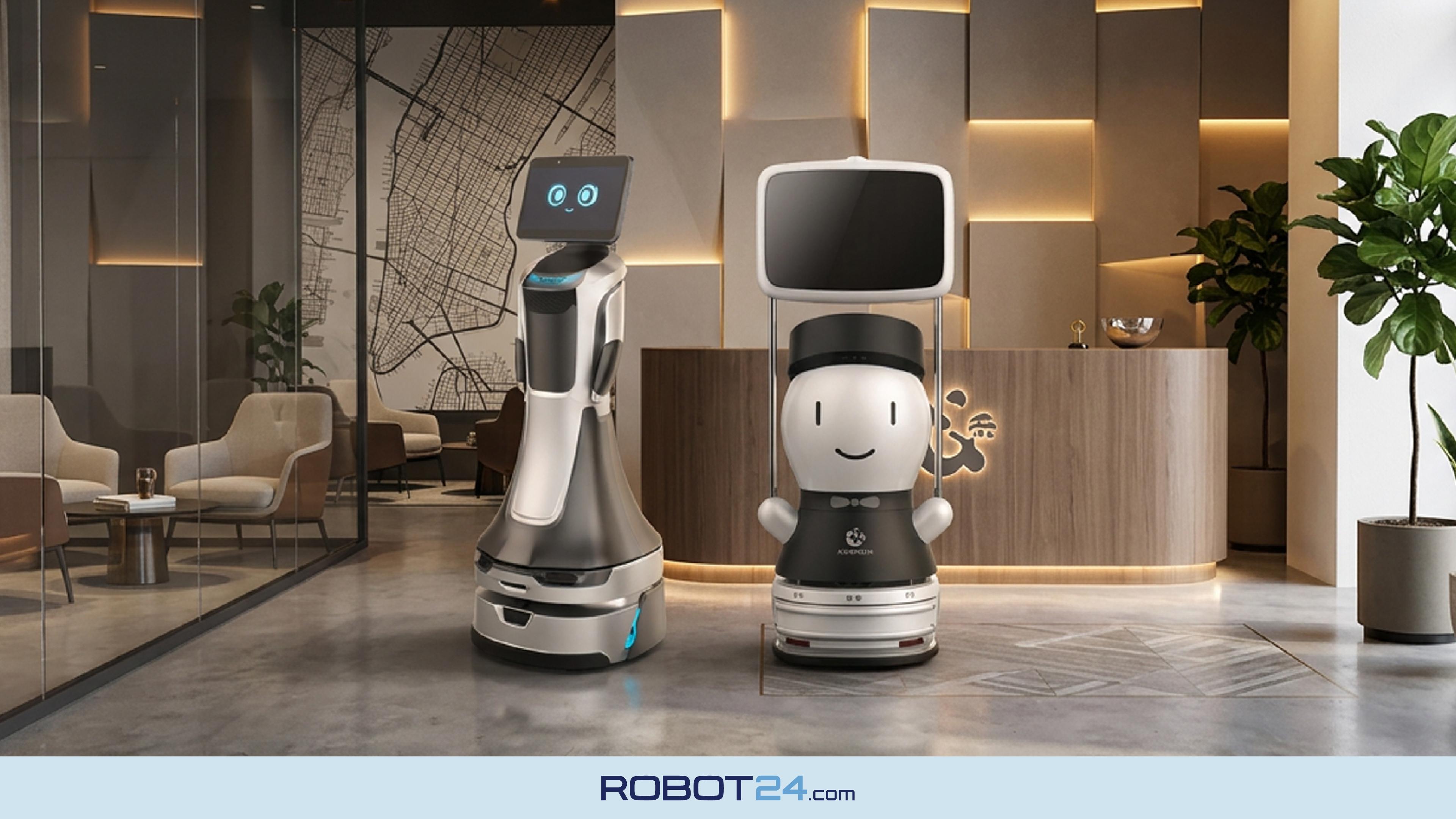
The OrionStar GreetingBot Mini and KEENON GUIDERBOT G2 share the same autonomous navigation, escort and fleet features, but differ sharply in build. The 21 kg Mini fits 55 cm passages and runs up to 12 hours, while the 70 kg G2 brings dual 21.5-inch displays for signage and advertising.

November 20, 2026 by Business Desk Team
Introduction
OrionStar GreetingBot Mini and KEENON GUIDERBOT G2 are examples of commercially produced autonomous robots for the purpose of greeting, guiding and interacting with people in indoor environments. The robots are both manufactured in China and have a common purpose of being used in areas such as hospitality, retail and showroom facilities, healthcare institutions.
The two robots feature many similar characteristics. They both allow for the usage of autonomous navigation, LiDAR, mapping, human detection, obstacle detection and avoidance, guided escort, connection to the cloud and operation of multiple robot fleets.
However, the difference between the two lies in their appearance and physical parameters. GreetingBot Mini is a small-sized robot measuring 1,000 mm and weighing 21 kg. It features a 14-inch FHD touchscreen. The GUIDERBOT G2 is quite a large robot measuring 145 cm and weighing 70 kg net and having two 21.5-inch HD screens for visibility purposes.
In addition, the operating time differs for the two models. GreetingBot Mini is characterized by up to 12 hours of running time and less than 4.5 hours of charging time, while the GUIDERBOT G2 operates for at least 7 hours and needs 6 hours for charging.
This comparison is based on ROBOT24.com market-data records.
At a Glance
| Metric | OrionStar GreetingBot Mini | KEENON GUIDERBOT G2 |
|---|---|---|
| Robot type | Wheeled service robot | Wheeled UGV |
| Typical use | Hospitality; retail & showroom operations; healthcare | Hospitality; retail & showroom operations; healthcare |
| Height | 1,000 mm | 1,450 mm |
| Width | 410 mm | 600 mm |
| Weight | 21 kg | 70 kg (net) |
| Minimum passage width | 55 cm | 70 cm |
| Drive system | Autonomous mobile base | Autonomous mobile base |
| Display | 14-inch FHD touchscreen | Dual 21.5-inch HD displays |
| Resolution | 1920 × 1080 | 1080p |
| Runtime | Up to 12 hours | 7 hours or more |
| Charging time | 4.5 hours or less | 6 hours |
| Navigation | LiDAR SLAM | SLAM |
| LiDAR | Yes | Yes |
| Autonomous navigation | Yes | Yes |
| Indoor mapping | Yes | Yes |
| Human detection | Yes | Yes |
| Obstacle detection | Yes | Yes |
| Obstacle avoidance | Yes | Yes |
| Guided escort mode | Yes | Yes |
| Cloud connectivity | Yes | Yes |
| Fleet operation | Yes | Supported |
| Multi-robot coordination | Yes | Supported |
| Price | Approx. $10,000–13,000 | Approx. $10,000–14,000 |
| Nationality | Chinese | Chinese |
| Availability | Through OrionStar regional suppliers by quotation; installation and delivery depend on location | Through KEENON regional suppliers by quotation; stock and delivery require supplier confirmation |
| Status | Commercial | Commercial |
Source: ROBOT24.com market-data records.
How They Compare
Both robots target visitor-facing service work in commercial buildings and share an almost identical recorded software and autonomy feature set. Each supports LiDAR-based SLAM navigation, indoor mapping, human and obstacle detection, obstacle avoidance, guided escort mode, cloud connectivity and multi-robot fleet coordination.
The biggest difference is size. The GreetingBot Mini stands 1,000 mm tall, measures 410 mm wide and weighs 21 kg. The GUIDERBOT G2 stands 1,450 mm tall, measures 600 mm wide and weighs 70 kg net, more than three times as heavy.
That size gap shapes where each robot can work. The GreetingBot Mini needs a passage only 55 cm wide, making it better suited to tight reception areas, narrow retail aisles and crowded front desks. The GUIDERBOT G2 needs at least 70 cm, so it fits more open spaces such as lobbies, mall concourses and showroom floors.
The displays reflect two different approaches. The GreetingBot Mini carries a single 14-inch FHD touchscreen at 1920 × 1080, built for close, one-to-one interaction. The GUIDERBOT G2 carries dual 21.5-inch HD displays at 1080p, giving it far more screen area for signage, wayfinding and advertising visible from a distance.
Endurance favors the GreetingBot Mini. It is recorded with up to 12 hours of runtime and a charging time of 4.5 hours or less. The GUIDERBOT G2 is recorded with at least 7 hours of runtime and a 6-hour charging time, which may require more careful scheduling around peak hours.
Pricing in the Robot24 records is close. The GreetingBot Mini is listed at approximately $10,000–13,000 and the GUIDERBOT G2 at approximately $10,000–14,000. Both are sold through regional suppliers by quotation, so final pricing and delivery depend on location.
Summary
The GreetingBot Mini and the GUIDERBOT G2 belong to the same class of autonomous guidance and reception robots. Their recorded navigation, safety, escort and fleet features are essentially the same, as are their target industries and price range.
What sets the GreetingBot Mini apart is its compact, lightweight build, its narrow 55 cm passage requirement and its longer endurance of up to 12 hours with a charge of 4.5 hours or less. It suits venues where space is tight and the robot must work long shifts with little downtime.
What sets the GUIDERBOT G2 apart is its physical presence and its dual 21.5-inch displays. Its larger frame and screen area make it the stronger choice where visibility, signage and advertising matter more than maneuvering in tight spaces.
The deciding factor is not autonomy but the operating environment. Buyers with compact spaces and long operating days will lean toward the GreetingBot Mini, while those with open venues and a focus on visual engagement will lean toward the GUIDERBOT G2.
More articles on this topic
170 articles ReportRichtech DUST-E S vs. Gausium Phantas
 ReportEngineAI SE01 vs. AGIBOT RAISE A1ReportRichtech DUST-E S vs. KEENON KLEENBOT C20
 ReportAGIBOT G2 vs. KEENON XMAN-F1
 ReportAGIBOT A2 vs. Unitree G1
 ReportPUDU FlashBot vs. KEENON DINERBOT T3
 ReportPUDU CC1 Pro vs. KEENON KLEENBOT C40
 ReportPUDU ET1 vs. KEENON KLEENBOT C20
 ReportUniRing MAX vs. KEENON KLEENBOT C40
 ReportAGIBOT X2 vs. Unitree R1
 ReportPUDU CC1 vs. UniRing MAX
 ReportPUDU KettyBot vs. KEENON DINERBOT T8
BUSINESS NEWS WEEKLY LETTER
The Weekly Letter for Robotics Professionals, Summarizing the Most Important Industry Moves, Launches, Deals and Signals.