Healthcare And Care Robots: Which Companies Are Building Robots For Hospitals, Clinics, Elderly Care?
Hospitals, pharmacies, and elder-care programs are all investing in robots, but the businesses behind them look nothing alike—from Intuitive Surgical's 11,710 installed da Vinci systems to a South Korean companion doll subsidized by municipal welfare offices.

September 7, 2026 by Business Desk Team
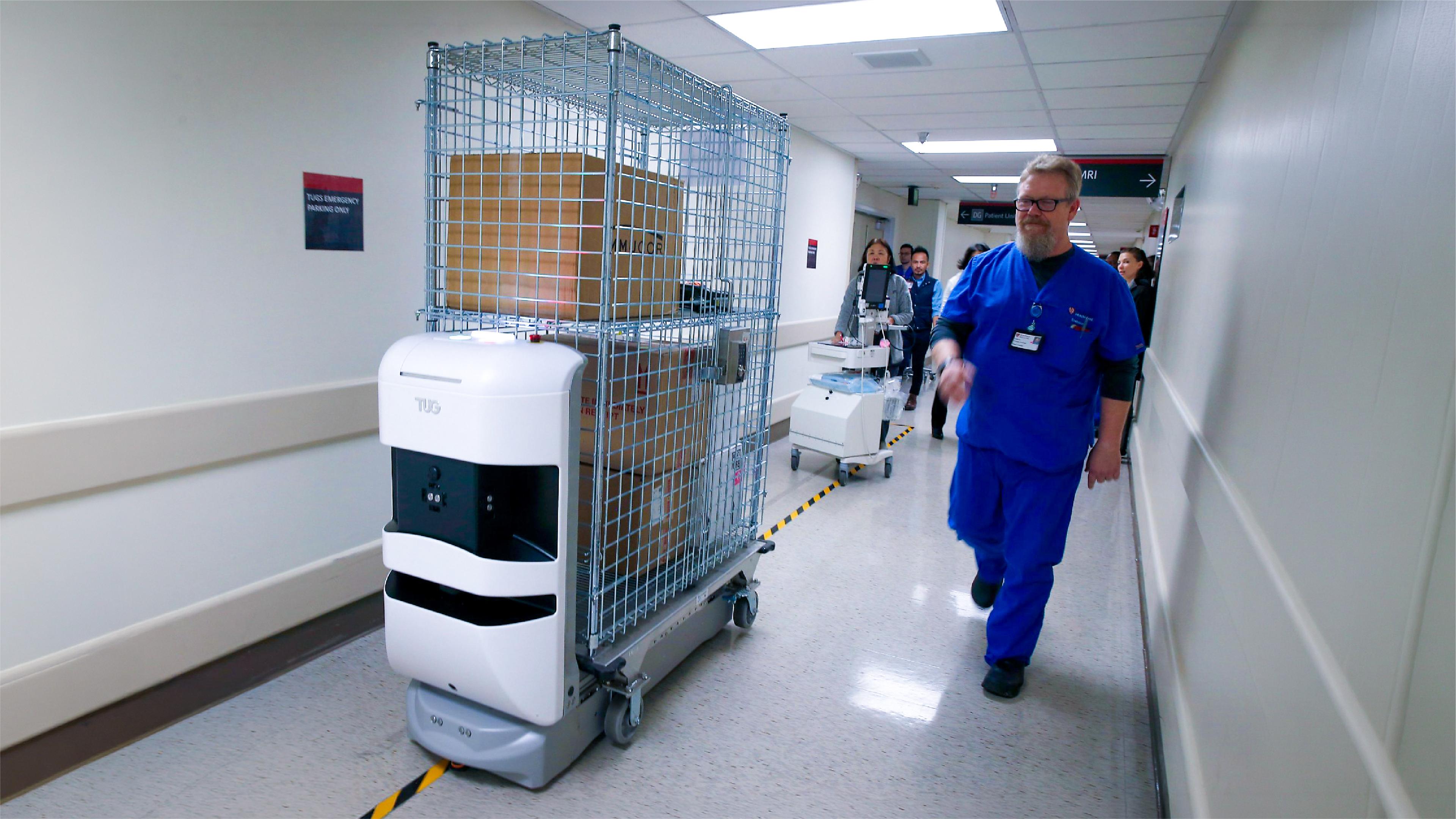
Ask what a "healthcare robot" is, and the answer depends on who you're asking. To a surgeon, it's a $2 million system that has assisted in millions of procedures. To a hospital administrator, it might be an autonomous cart pulled from service after two years. To a family in Seoul, it's a companion doll checking in on an aging parent.
Here's who's actually building these robots, and what the numbers reveal.
Stryker's Mako has logged 2.5 million procedures. MultiCare, a Washington State health system, retired its entire fleet of delivery robots within two years. South Korea has over 12,000 companion robots in seniors' homes; a French humanoid maker went bankrupt within the same year.
Serve Robotics paid $29.0 million in stock for Diligent Robotics in January 2026, with a further $5.3 million riding on an earn-out.
The deal disclosure counted roughly 100 Moxi autonomous mobile robots working across more than 25 US hospital facilities. Those robots had completed over 1.25 million deliveries.
Six months later, Intuitive Surgical told investors it had 11,710 da Vinci surgical systems installed worldwide as of 30 June, up 12% on the year. It had shipped 899 of them since January, according to its second-quarter release.
Precedence Research values the medical robots market at $15.59 billion for 2025, with $18.32 billion projected this year. Surgical systems take more than 64% of that revenue; hospitals account for more than 67% of end use. The fastest-growing product line in its forecast is pharmacy and hospital automation.
Who is challenging da Vinci?
The FDA cleared Medtronic's Hugo system for urologic procedures on 3 December 2025. MedTech Dive called it the first new soft-tissue surgical robot from a major device maker to reach the US market since da Vinci in 2000.
Cleveland Clinic performed the first American Hugo case on 17 February. In June, Medtronic filed to add general surgery and gynaecology.
Medtronic has not disclosed the size of Hugo's global installed base. Stifel analysts quoted by MedTech Dive at the time of clearance expected a slow, deliberate launch.
Stryker bought Mako in 2013. On its second-quarter call this year, the company said Mako had supported more than 2.5 million procedures in 47 countries—its strongest installation quarter yet. Edge Medical listed in Hong Kong on 8 January and closed its first day 30.9% up.
Its prospectus states 60 MP1000 systems sold worldwide by 30 June 2025, a loss in every period reported, and no FDA clearance.
China's hospitals procure surgical robots through public tenders; these results show how Edge fares against da Vinci in its home market. In the 2025 round of laparoscopic-system tenders, da Vinci won 43 of 90 units awarded. Edge won about 16.
Some healthcare robots are here to stay… Others, not so much
MultiCare bought 14 Moxi units, essentially nursing robots, in 2023.
MultiCare had retired all of them within two years.
Vendors in this category commonly cite two to three hours of nursing time freed up each day. Washington State Nurses Association, representing MultiCare's nurses, said the robot needed an escort between floors and didn't free up meaningful time; nurses gave the same account to Proof News.
Aethon has been selling TUG delivery robots since 2004 and has belonged to ST Engineering since a $36 million deal in 2017. It has not disclosed a dated installed-base figure.
Hospitals in Japan and Singapore adopted Panasonic’s HOSPI autonomous robot delivery system since the robot went on sale in October 2013.
Who's automating the pharmacy?
"Clinic robot" is a looser category than "hospital robot." Most of the disclosed activity sits in pharmacy automation rather than a distinct clinic-floor machine.
Omnicell, the largest disclosed player, reported $310 million in first-quarter 2026 revenue and said its automated dispensing cabinets and central-pharmacy robotics continue to expand across hospital and specialty-pharmacy settings.
The company's oldest XT cabinets were first shipped in 2017. Omnicell estimates the replacement-cycle opportunity for that installed base at more than $2.5 billion over the long term.
Its newer Titan XT platform, announced in December 2025, is due to start shipping in the latter half of 2026.
Does clearance mean sales?
Wandercraft's Atalante X rehabilitation exoskeleton has carried FDA clearance since 2022, extended again in November 2025.
The French company told Sifted it had sold about 110 units at roughly €200,000 apiece, having raised a $75 million Series D led by Renault in June 2025.
Its personal exoskeleton, Eve, cleared the FDA on 11 August. It goes on sale on 17 September.
Lifeward, previously ReWalk, got a Medicare rate averaging $91,032 per personal exoskeleton onto the CMS fee schedule, effective 1 April 2024.
Fourier Intelligence is often credited with thousands of hospital installations. That figure—more than 2,000 hospitals and institutions—belongs to the rehabilitation business it has run since 2015. The GR-3 care humanoid it launched last August has no named hospital pilot.
Who's building for elderly care at home?
The elderly-care segment runs on a different kind of disclosure than hospitals do—funding rounds and government pilot numbers, not FDA filings or earnings calls.
South Korea's Hyodol, a plush companion doll aimed at seniors living alone, had over 12,000 units deployed as of November 2025, most distributed through government and public welfare programs, according to CNN.
Intuition Robotics' ElliQ, a tabletop AI companion, expanded to Japan in September 2025 through a partnership with trading company Kanematsu, which invested to bring Intuition's total equity funding to $85 million.
That was the company's first international expansion outside the US. A Japan launch is targeted for 2026.
Not every entrant in this category has survived. Aldebaran, the French maker of the Pepper and Nao humanoid robots once widely deployed in research and service settings, filed for bankruptcy in February 2025 and was placed in judicial liquidation that June, after its majority owner cut funding the previous year. Its assets were later acquired by China's Maxvision Technology.
Fourier Intelligence's GR-3 care humanoid, mentioned above for its lack of a named hospital pilot, is entering this same elderly-care space—one where an established, well-funded predecessor already went under.
Is labor shortage the driver?
The WHO's State of the World's Nursing 2025 projects the global shortfall falling from 5.8 million nurses in 2023 to 4.1 million by 2030, concentrated in Africa and the Eastern Mediterranean.
Japan carries the heaviest demographic load of any market, given its aging population. The Eastern Asian nation’s Ministry of Health, Labour and Welfare (MHLW) and the Ministry of Economy, Trade and Industry (METI) have been promoting initiatives aimed at enhancing the quality of caregiving services, reducing staff burdens, and supporting the independence of elderly individuals via caregiving robots and ICT technologies.
Taiwan put NT$1.8 billion into night-shift pay and staffing ratios instead, AmCham Taiwan reported.
What has Serve Robotics reported since?
Serve Robotics, a prominent player in the industry, published second-quarter results on 6 August: seven multi-year contract extensions signed with hospital customers and two new hospitals added over the first half.
Healthcare "delivered steady revenue in Q2 in line with expectations," the release said.
Total revenue for the quarter was $3.2 million. The company did not share the specific details about their hospital business in their report.
Healthcare robots are here to stay
One thing holds across every category here: robots are a winner when they produce a number worth paying for again and again: procedures done, deliveries made, minutes genuinely saved. This is an industry where the novelty of the technology quickly wears off in the face of lackluster utility and functionality. That's also why the field keeps refilling with new entrants even as earlier ones fail: the payoff for cracking that formula is big enough to keep the bets coming.
More articles on this topic
110 articles ReportMaxinsights Updates $30M Robot Training Funding Release
 ReportChina's Humanoid Supply Chain Moves Toward Industrial Production
 ReportFFR Sees 2,000 Robot Shipments in 2026 as Faraday Deal Closes
 ReportFormer OpenAI Executive Raises $215M for Robotic Labs
 ReportAgility Expands Humanoid Rollout With GXO to Two More US States
 ReportEnact Intelligence Raises $30M for Development of Force-Aware Robots
 ReportChina Launches First National Standards for Humanoid Robots
 ReportDEEP Robotics Reports Navigation Gains With New Embodied AI Models
 ReportResearchers Show How Two Letters Can Manipulate Robot Behavior
 ReportAI Built on Human History LLMs Will Repeat Human History
 ReportTeradyne, Sereact Expand Physical AI From Research to Industry
 ReportRobot Makers Collaborate with Universities in Race to Advance Humanoids
BUSINESS NEWS WEEKLY LETTER
The Weekly Letter for Robotics Professionals, Summarizing the Most Important Industry Moves, Launches, Deals and Signals.