Inside Robostral Navigate, Mistral AI’s New Navigation Model for Robots
Mistral AI said Robostral Navigate will unlock numerous applications across manufacturing, delivery, logistics, and hospitality.

July 10, 2026 by Nikita
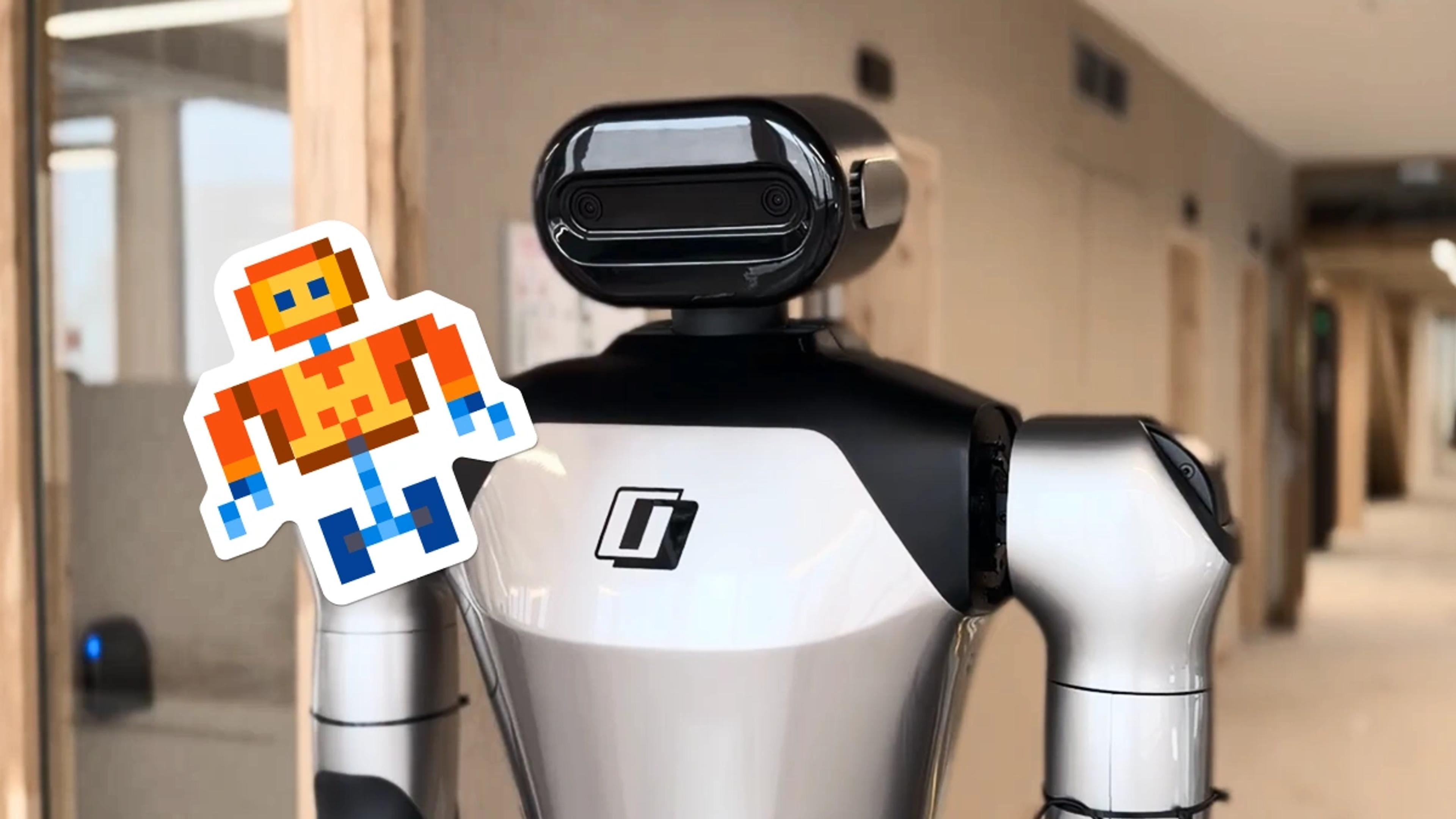
Paris-based Mistral AI this week unveiled its first robotics AI model, Robostral Navigate, marking its entry into physical AI for industrial automation.
In a press release, the artificial intelligence startup said Robostral Navigate is designed in-house to help robots understand their surroundings by taking RGB images and instructions in plain language. The model does not rely on any existing open-source vision-language models (VLMs).
While other models often depend on depth sensors, LiDAR, or several cameras working together, Mistral’s robotics AI model uses only one ordinary RGB camera and no depth sensors, “yet still achieves 76.6% on R2R-CE (Room-to-Room in Continuous Environments) validation unseen, the benchmark for following instructions in environments held out of training.”
Mistral said its model can enable robots to autonomously navigate complex environments, including offices, residential and commercial buildings, and factories and warehouses. The model can run on wheeled, legged, and flying robots, as well as generalised across robot sizes.
The startup added that Robostral Navigate will unlock numerous applications across manufacturing, delivery, logistics, and hospitality, making it one of the most in-demand capabilities today.
“Give Robostral Navigate one instruction, and it completes the entire task on its own, moving through a live space full of people and obstacles it was never shown, capable of adapting to any setting,” the company said in a statement.
The French company joins a list of growing AI firms competing to develop software for the robotics industry to help them operate safely in real-time settings.
According to Mistral, Robostral Navigate “predicts where the robot should move next via pointing: it infers the image coordinates of the target location in the robot’s current camera view, together with the desired orientation upon arrival.”
Unlike commands relying on metric displacements, pointing makes the policy naturally robust to changes in camera intrinsics and world scale, the company explained.
However, this method, it said, cannot handle cases where the target location lies outside the current field of view.
“The model is initialised from our VLM specialised for grounding tasks such as pointing, counting, and object localisation. Navigation emerges as a natural extension of these capabilities: once it understands where things are, it learns how to move,” Mistral said in a statement.
The Paris-headquartered AI startup has built an efficient data-generation pipeline entirely in simulation, enabling rapid iteration on the data and resulting in a dataset of about 400,000 trajectories collected across 6,000 scenes.
“Compared to training with one sample per time step, our approach reduces the number of training tokens by 22x while preserving all of the learning signals. In practice, this method transforms training runs that would take months into runs that complete in days,” Mistral said about its training algorithm.
More articles on this topic
60 articles ReportChina Is Sending Humanoid Robots To School
 ReportA Humanoid Walks into a New York Park
 ReportChina's Humanoid Supply Chain Moves Toward Industrial Production
 ReportCompanionship now comes with a Charging Cable
 ReportChina Launches First National Standards for Humanoid Robots
 ReportAI Built on Human History LLMs Will Repeat Human History
 Report6 Unusual Jobs Done By Robots
 ReportThis AI Robot Is Learning To Pick Tomatoes Like A Human
 ReportHumanoid Robots Join Human Dancers As WorldSkills 2026 Opens In Shanghai
 ReportRobot Dog Completes Full Marathon on a Single Battery Charge
 ReportAgiBot, Chimelong Set To Open Large-Scale Robot Theme Park
 ReportCoca-Cola’s Chinese Bottler Turns To Robots For The Heavy Lifting
BUSINESS NEWS WEEKLY LETTER
The Weekly Letter for Robotics Professionals, Summarizing the Most Important Industry Moves, Launches, Deals and Signals.