DEEPRobotics LYNX M20 Pro vs. Unitree B2-W
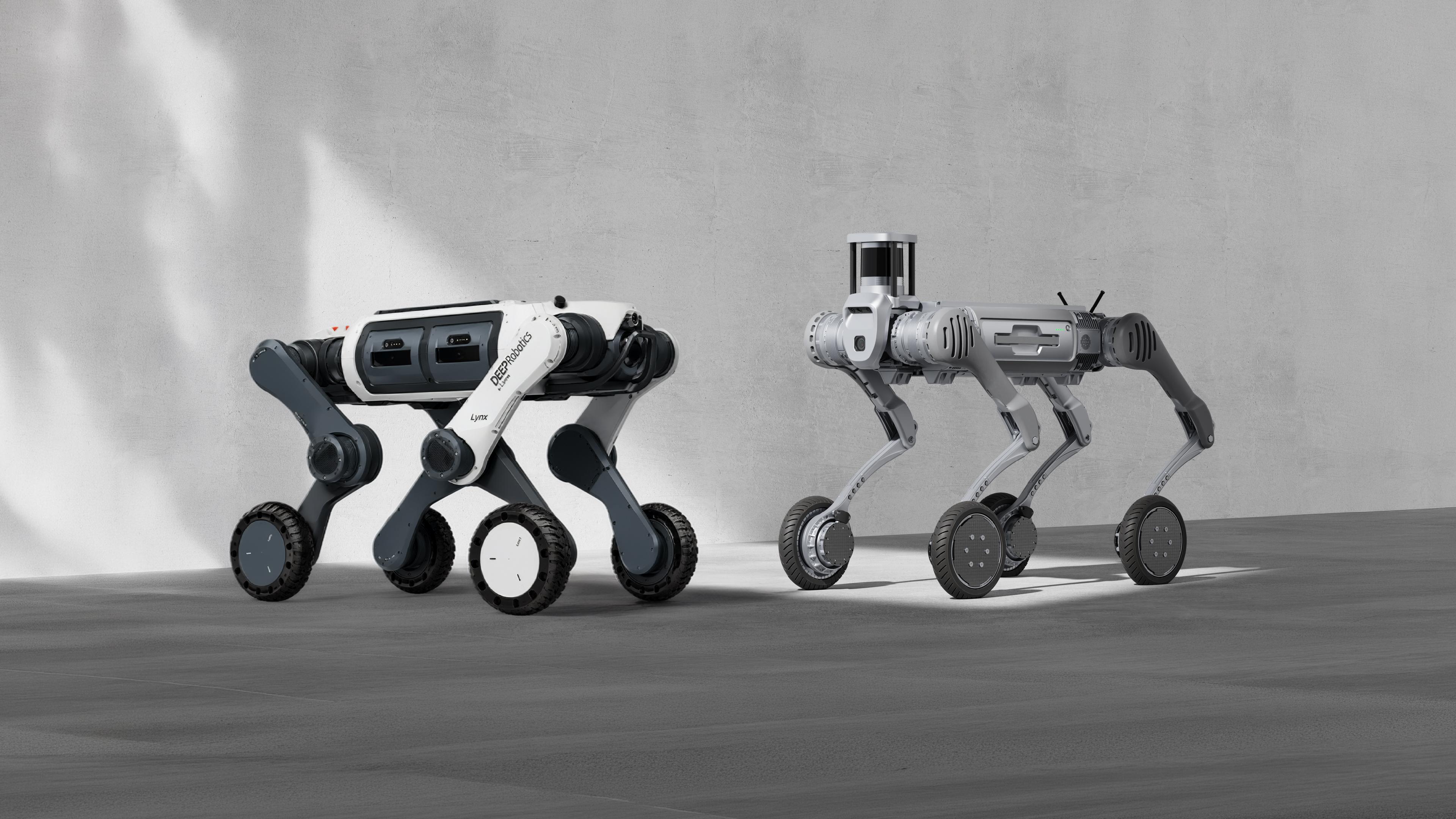
The DEEPRobotics LYNX M20 Pro and Unitree B2-W combine wheeled mobility with legged locomotion to navigate challenging terrain. While the LYNX M20 Pro emphasises compact design, obstacle negotiation and field versatility, the B2-W focuses on higher payload capacity and extended range. This comparison examines their mobility, endurance, payload, navigation and environmental protection to help identify which platform better suits demanding industrial and field operations.

October 26, 2026 by Business Desk Team
Introduction
DEEPRobotics LYNX M20 Pro and Unitree B2-W are wheeled-legged quadruped robots which can handle terrain that is difficult for traditional wheeled robots. Both use a hybrid of wheels and legs to get around rough terrain, slopes and obstacles. But they have different primary use case.
Features of DEEPRobotics LYNX M20 Pro Unitree B2-W in comparison to the DEEPRobotics LYNX M20 Pro highlight the platform's suitability for last-mile delivery, logistics, outdoor fieldwork and exploration. The Unitree B2-W appears to have a focus on endurance, greater payload and efficient mobility.
The real question is not which robot is faster or which can carry more weight, but which platform fits the payload, terrain and operational criteria of the mission the best.
At a Glance
| Metric | DEEPRobotics LYNX M20 Pro | Unitree B2-W |
|---|---|---|
| Robot type | Wheeled-legged quadruped robot | Wheeled-legged quadruped robot |
| Best-fit use cases | Last-mile delivery, logistics, outdoor exploration and field operations | Industrial operations, research, inspection and all-terrain mobility |
| Dimensions (standing) | 820 × 430 × 570 mm | Approx. 1,098 × 550 × 758 mm |
| Weight (with battery) | Approx. 33–35 kg, depending on published specification | Approx. 85 kg |
| Payload / load capacity | 15 kg effective payload; 50 kg maximum load capacity | Over 40 kg while moving; 120 kg maximum standing load |
| Endurance / range | Up to 3 h / 15 km unloaded; 2.5 h / 12 km with 15 kg payload | Up to 30 km unloaded; up to 25 km with a 40 kg load, according to manufacturer figures |
| Maximum speed | 5 m/s lab-tested; 2 m/s maximum working speed | Up to 15 km/h, subject to configuration and safety limits |
| Stair / obstacle capability | 25 cm continuous stair height; up to 80 cm single-step height | 20–25 cm continuous stairs; forward stair traversal up to 40 cm |
| Slope capability | Up to 45° under specified test conditions | Greater than 45°, according to manufacturer specifications |
| Navigation / sensing | Dual 96-line LiDAR units, dual wide-angle cameras and SLAM navigation | Sensor and computing configurations vary; optional configurations are available |
| Environmental protection | IP66 | IP67 |
| Battery / charging | Hot-swappable batteries; approximately 1.5–2 h charging per battery, depending on specification | Battery capacity above 2 kWh; charging details depend on configuration |
| Distinctive capabilities | Compact footprint, obstacle clearance, dual LiDAR and optional autonomous charging | Higher moving-load capacity, longer stated range and larger battery system |
| Key limitation / caveat | Shorter stated range and lower payload capacity than the B2-W | Larger, heavier platform; confirm the configured sensor package and actual mission endurance |
Information provided is based on manufacturer specifications and are subject to change. Variation between models and testing conditions will exist. Standing load does not represent driving payload capacity.
How They Compare
Operational role: The LYNX M20 Pro is designed for missions where compact dimensions, all-terrain mobility and a comparatively lightweight platform are valuable. Typical use cases include logistics, last mile delivery, and outdoors exploration. The B2-W has a larger payload capacity and longer travel, which also makes it worth considering for challenging industrial and research use cases.
Payload and endurance: The LYNX M20 Pro indicates a payload of 15 kg and endurance of 2.5 hours with payload. Unitree states a moving load of over 40 kg and a maximum range of 25 km with a payload of 40 kg. While this indicates a large variance in payload capacity, payload endurance and range should be confirmed over similar terrain and speed and operational profiles.
Mobility and obstacle navigation: Both platforms use wheels and legs for terrain transition. The LYNX M20 Pro has an 80cm max single step and 25cm continuous stair height. The B2-W offers forward stair navigation up to 40cm and continuous stair climbing of 20-25cm. These are different test parameters and should not be seen as comparable obstacle course figures.
Navigation and deployment: The LYNX M20 Pro mentions dual 96-line LiDAR, dual wide-angle cameras, and SLAM mapping and navigation. Unitree's sensing and computing solutions will vary by configuration. Consumers should ensure sensor coverage, autonomous navigation capability, integration needs, charging setup, and ecosystem support before deploying.
Environmental resilience: The LYNX M20 Pro is IP66; B2-W is IP67. Dust and water ingress protection ratings are based on specific, test conditions and do not necessarily guarantee protection in all outdoor or hazardous areas.
Important Qualification
DEEPRobotics LYNX M20 Pro: Its small size and stated obstacle clearance could make it well-suited for restricted pathways and multi-environment operations. Its published 15 kg effective payload and 2.5-hour loaded endurance should be scaled against the actual payload and task.
Unitree B2-W: Consider using this model if you have mission requirements that need increased payload capacity and a longer published range. Note that the larger footprint, weight, and configuration-dependent sensor package requirements may impact your deployment considerations.
Manufacturer maximums are not to be understood as a criterion of garanteed performance in continous wide open operating in field. No specification sheet establishes a overal superiority in practice.
Summary
Consider the DEEPRobotics LYNX M20 Pro if the size and weight of the robot are critical to mission success. Opt for the Unitree B2-W if more moving-load capacity and range supersedes minimising the robot's size and weight.
The ultimate choice should be based on the route profile, payload weight and configuration, operational time required, level of autonomy and integration, and maintenance and technical support available. Conducting a field test under real load conditions on the actual terrain is the most accurate indication of suitability.
This comparison is based on ROBOT24.com market-research data records and manufacturer-reported specifications rather than controlled performance testing.
More articles on this topic
86 articles ReportRichtech DUST-E S vs. Gausium Phantas
 ReportEngineAI SE01 vs. AGIBOT RAISE A1ReportRichtech DUST-E S vs. KEENON KLEENBOT C20
 ReportRobint Rhino vs. OrionStar CleaniBot S55 Pro
 ReportNilfisk Liberty SC50 vs. PUDU CC1
 ReportHusqvarna Automower 305 vs. Robomow RK 1000
 ReportMirokaï vs. NUWA Kebbi
 ReportUnitree G1 EDU vs. Booster K1
 ReportECOVACS DEEBOT X8 PRO OMNI vs. eufy X10 Pro Omni
 ReportCleanfix S170 Navi vs. OrionStar CleaniBot K1
 ReportCleanfix S170 Navi vs. Nexaro NR 1700
 ReportReeman Nurse vs. Robotise JEEVES
BUSINESS NEWS WEEKLY LETTER
The Weekly Letter for Robotics Professionals, Summarizing the Most Important Industry Moves, Launches, Deals and Signals.