Why NVIDIA is a Trusted Tech Partner for Global Robotics Manufacturers
Agility Robotics has become the first company to incorporate elements of NVIDIA Halos for Robotics into its proprietary safety system to build safety into humanoids working in its factories, warehouses, and logistics operations.

July 8, 2026 by Nikita
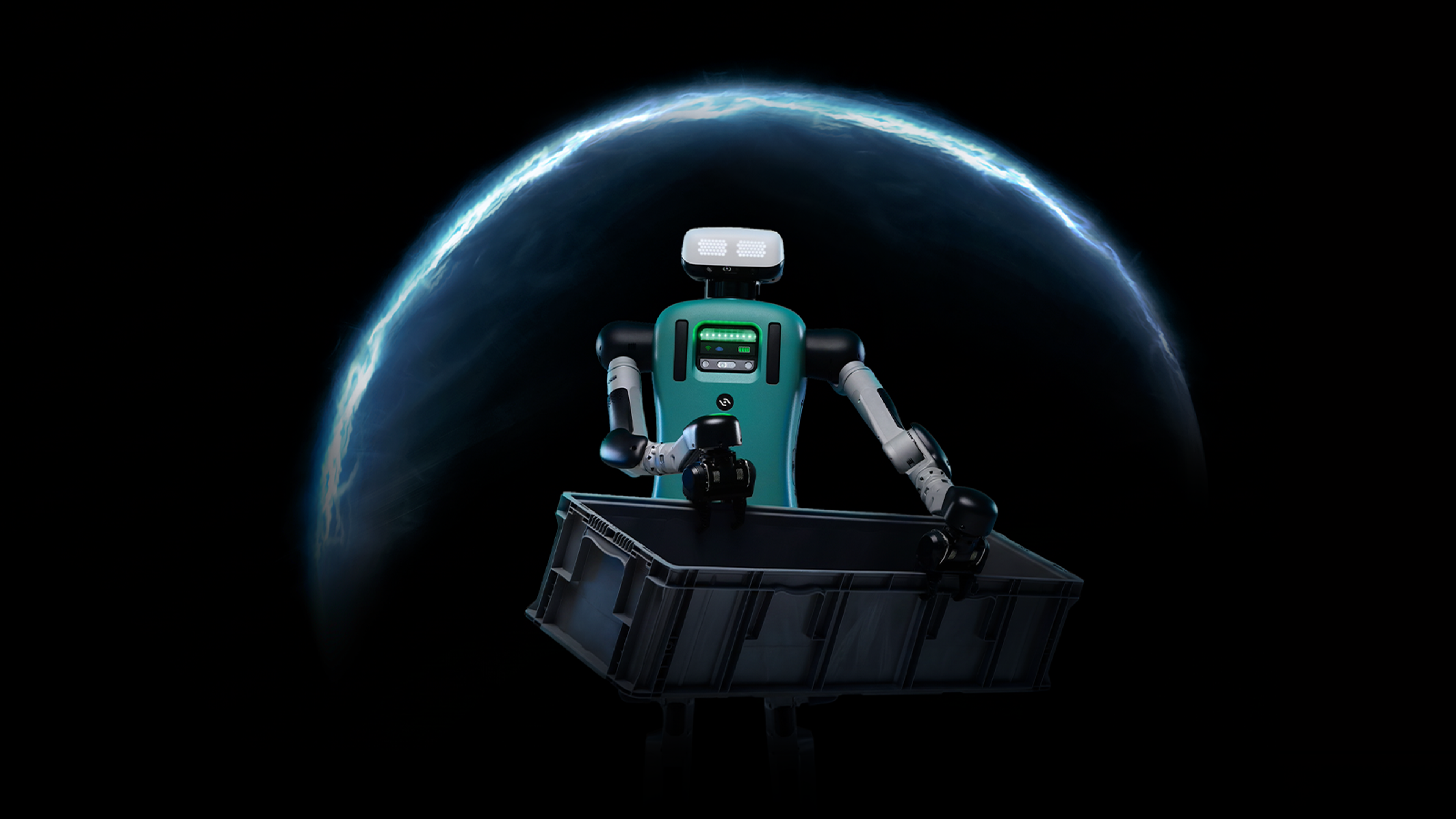
Chip maker NVIDIA last month introduced NVIDIA Halos for Robotics—the industry’s only full-stack, open robotics safety system—extending the technology deck made for autonomous vehicles to the world of robotics and physical AI.
“With NVIDIA Halos for Robotics, developers and system builders can harness NVIDIA’s proven autonomous vehicle safety foundation to develop safer robots faster and bring them into industrial operations alongside workers with greater confidence,” said Deepu Talla, Vice President of Robotics and Edge AI at NVIDIA, in a statement.
With this launch, Agility Robotics, the humanoid robotics and physical AI innovator, became the first company to incorporate elements of Halos for Robotics into its proprietary safety system to build safety into humanoids working in its factories, warehouses, and logistics operations for customers, including Amazon, GXO, Schaeffler, and Toyota Motor Manufacturing Canada, the company said.
NVIDIA has built safety into every layer of its new technology stack—with NVIDIA IGX Thor and Holoscan Sensor Bridge for AI compute and sensor connectivity, the Halos OS software stack for safety functions and applications, and the NVIDIA Halos AI Systems Inspection Lab to help manufacturers prepare for third-party certification with confidence.
This is the US-based chip maker’s latest offering as it bets big on the growing robotics sector.
Earlier in March at its GPU Technology Conference (GTC), it unveiled NVIDIA Isaac simulation frameworks and new NVIDIA Cosmos and NVIDIA Isaac GR00T open models for the industry to develop, train, and deploy the next generation of intelligent robots.
Among the industry leaders building on the NVIDIA platform are ABB Robotics, AGIBOT, Agility Robotics, FANUC, Figure, Hexagon Robotics, KUKA, Skild AI, Universal Robots, World Labs, and YASKAWA.
Here’s how robotics manufacturers are utilising NVIDIA’s tech stack:
Manufacturers like FANUC, ABB Robotics, YASKAWA, and KUKA integrate the NVIDIA Omniverse libraries and NVIDIA Issac simulation frameworks into their virtual commissioning solutions to develop and validate complex robot applications and production lines through physically accurate digital twins, NVIDIA said.
“To power advanced intelligence on the production line, the companies are integrating NVIDIA Jetson modules into their controllers for real-time AI inference at the edge,” the company added.
Robots also need human-like reasoning and the ability to perceive, decide, and act accordingly as they evolve from task-specific machines to reliable, adaptable specialist systems that work with precision for industrial-grade deployment.
Here, NVIDIA Cosmos world models for data generation and Isaac simulation frameworks help manufacturers validate policies in simulation, enabling any robot to master new tasks with minimal retraining. NVIDIA partners FieldAI and Skild AI are already building generalised robot brains on this tech stack.
Meanwhile, World Labs uses Isaac Sim to validate its generative world models, while Generalist AI leverages Cosmos to explore synthetic data generation.
Now, NVIDIA has launched Cosmos 3, the first world foundation model that unifies synthetic world generation, vision reasoning, and action simulation to accelerate the development of generalised robot intelligence for complex environments.
It also introduced Isaac Lab 3.0 in early access, enabling faster, large-scale robot learning on NVIDIA DGX-class infrastructure. Built on the new Newton physics engine 1.0 and the NVIDIA PhysX software development kit, the company said it adds multiphysics simulation and improved support for complex, dexterous manipulation.
Leaders, including 1X, AGIBOT, Agility Robotics, Agile Robots, Boston Dynamics, Figure, Hexagon Robotics, Mentee, and NEURA Robotics, are building the next generation of humanoids using Cosmos world models, Isaac Sim, and Isaac Lab to accelerate the development and validation of their robots.
Meanwhile, AGIBOT, LG Electronics, NEURA Robotics, and Noble Machines, among others, are adopting NVIDIA Isaac GR00T N models to accelerate industrial deployments of their humanoids.
The chip maker said that GR00T N1.7 is available in early access with commercial licensing, bringing generalised robot skills, including advanced dexterous control, to production-ready robot deployments.
Additionally, at the GTC, NVIDIA President and CEO Jensen Huang previewed GR00T N2, a next-generation robot foundation model based on DreamZero research. Built on a new world action model architecture, the new model helps robots succeed at new tasks in new environments more than twice as often as leading vision language action models, the company claimed. It is slated to be available by the end of 2026.
NVIDIA Jetson Thor robotic computing platform powers these systems, enabling developers to move from simulation training to real-world deployment with greater speed, intelligence, and reliability.
More articles on this topic
60 articles ReportChina's Humanoid Supply Chain Moves Toward Industrial Production
 ReportChina Launches First National Standards for Humanoid Robots
 ReportCounterpoint Expects Work Applications to Drive 90% of Humanoid Shipments by 2030
 ReportUnitree’s 'Superman' Robot Claims to Outrun Usain Bolt
 ReportForeign Investors And Tech Executives Pay Up To $15,000 To Tour China’s Factories
 ReportCan Certified Robots Compete With China's Cheap Patrol Bots?
 ReportQuadruped Robots Are Becoming Big Business: Here’s Why The US Is Targeting Chinese Makers
 ReportHumanoid Robots Hit Mass Production
 ReportHow Robots Are Learning to Read Minds?
 ReportAre Humanoid Robot Videos Misleading Us?
 ReportHow Do Collaborative Robots Increase Workplace Safety?
 ReportHow to Train a Humanoid Robot for Hard Work
BUSINESS NEWS WEEKLY LETTER
The Weekly Letter for Robotics Professionals, Summarizing the Most Important Industry Moves, Launches, Deals and Signals.