Railway Inspection Robots Search for Defects in Tracks
Engineers from England and India team up to find maintenance issues falling through the cracks.

October 27, 2026 by Dr Maulik Vyas
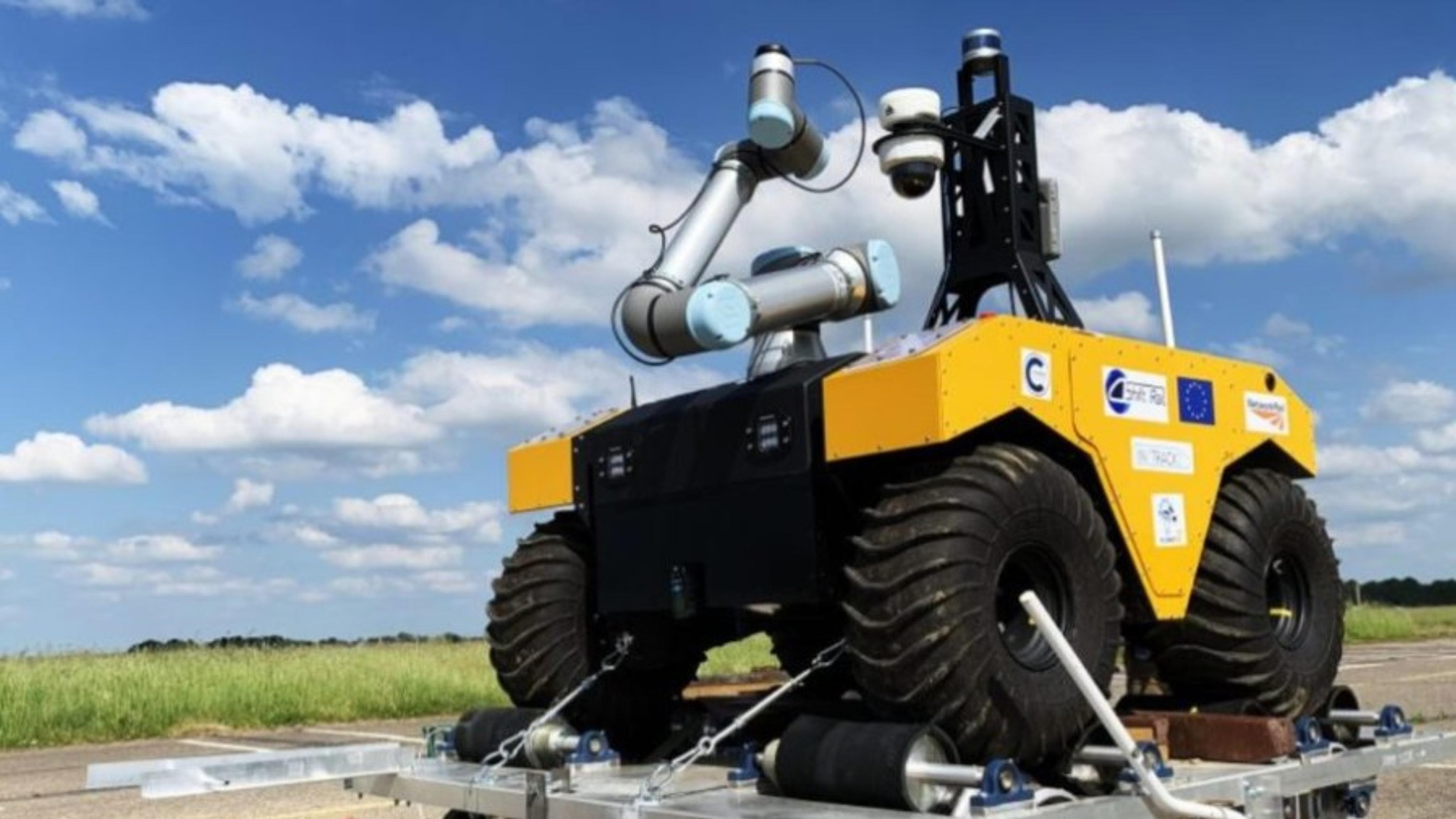
Cracks inside steel rail rarely show from the surface. A handful of real robots from England and India are learning to find them before a train does.
A rail can look perfectly fine and still carry a crack deep in its steel. Humans walk the line with handheld gear, and they do good work, but the job is slow and risky. Robots are now rolling onto the tracks to share it.
A crack you can’t see from the platform
Most rail defects start inside the head of the rail, where repeated wheel loads tire the steel. By the time a crack shows on the surface, it’s already well along. Ultrasonic testing finds the early ones, but someone has to carry the equipment out there.
That someone usually works in a short gap between trains, often at night, with a lookout watching for traffic. It’s tiring work. Tired people miss things. A machine rolling along the rail doesn’t care what time it is, and the projects below show how far that idea has already gone. The first one starts on an English test line with a rugged little vehicle.
A rugged vehicle on a test line
Cranfield University and Network Rail teamed up on a project called In2Smart 2 and used a Clearpath Warthog, a rugged unmanned ground vehicle. It carries the sensors and tools. A remote operator sends it on an inspection run through web-based software.
Inspection was only half the plan. The wider goal was a platform that could carry repair tools too, so one machine could spot a problem and help fix it. The team showed autonomous flaw detection with ultrasonics, and the measurements were repeatable in controlled conditions. Repeatable matters. An inspection tool that gives a different answer on every pass is no use to an engineer. Controlled conditions are one thing, though. A live railway is another.
A heritage railway in the countryside
Cranfield later paired an autonomous rail vehicle with Sperry’s ultrasonic testing system and a cloud-based AI analyzer. After a 15-meter trial at its own test area, the team moved to a heritage railway at Idridgehay in Derbyshire.
- Nine rounds over a 250-meter stretch
- Simulated defects found and reported to a command centre by email
- Positional error and detection rate both measured
- Weak 4G signal in the fields slowed communication and data uploads
That last bullet is a small detail, and an honest one. Rail corridors run through cuttings and open fields where phone signal drops, so data links matter nearly as much as sensors. Meanwhile, a very different design is aimed at keeping trains moving while it works.
Artemis and the robot that sits between the rails
Artemis, developed at IIT Madras in India, rides along the inner portion of the track, so trains keep running while it works. It carries ultrasonic, infrared and eddy current sensors, and it sends crack data back in real time so repairs can be planned.
The design holds a granted Indian patent and has been proven in the lab so far. That puts Artemis earlier on the road than the Cranfield prototype, which makes it a good picture of where this field sits. Plenty of ideas are in the pipeline, and each one adds a new way to look at a rail. Speed is the other half of the story, and a trolley in Birmingham went straight at it.
A trolley that doubles back
At the University of Birmingham, researcher Hamed Rowshandel built a robotic trolley for rolling contact fatigue cracks. It sweeps the rail at 5 to 20 km/h with an alternating current field measurement sensor. When it spots something, it rolls back and scans slowly.
That slow pass, up to 20 mm/s, measures how big each crack is, how deep it runs and how many sit in that stretch of rail. Human crews work the same way, quick look first and careful look second. The trolley simply does both without a person kneeling beside the track. The sensors doing all this seeing deserve a quick look themselves.
Four senses, one job
Ultrasonic probes send sound into the steel and listen for echoes that bounce off hidden flaws, much like a ship’s sonar. Eddy current and field measurement sensors read tiny disturbances in electrical or magnetic fields, which gives away cracks near the surface.
Cameras and infrared sensors handle visual checks, and some designs add GPS and wheel encoders so each defect lands on a map. Put them together and a robot hand an engineer a located, sized defect instead of a vague mark in a notebook. That’s a better starting point for any repair crew.
Railways will keep needing people who read the data and decide what to fix. The robots just get them better information sooner. Keep following Robot24 for more stories from the field, and check which inspection robot fits your line.
More articles on this topic
235 articles ReportWhat it Really Costs to Own a Personal Assistant Robot at Home
 ReportA Little Company, Courtesy of a Robot
 ReportA Humanoid Walks into a New York Park
 ReportChina's Humanoid Supply Chain Moves Toward Industrial Production
 ReportCompanionship now comes with a Charging Cable
 ReportCould a Robotic Guide Help Blind Travelers Navigate Public Spaces?
 ReportThis Robot Finds Cracks and Fixes Them
 ReportXPENG's IRON Humanoid Adapts to Changing Human Gestures in Real Time
 ReportRobots Are Learning to Sort Clothes for Textile Recycling
 Report110 Humanoid Robots Set Guinness World Record With Synchronized Dance
 ReportScientists Teach Humanoid to Climb Ladders and Survive Falls
 ReportThe Robot to Fill Potholes and Change How Road Repairs are Done
BUSINESS NEWS WEEKLY LETTER
The Weekly Letter for Robotics Professionals, Summarizing the Most Important Industry Moves, Launches, Deals and Signals.