How Holiday Robotics’ $105M fundraise will make FRIDAY ready for manufacturing jobs
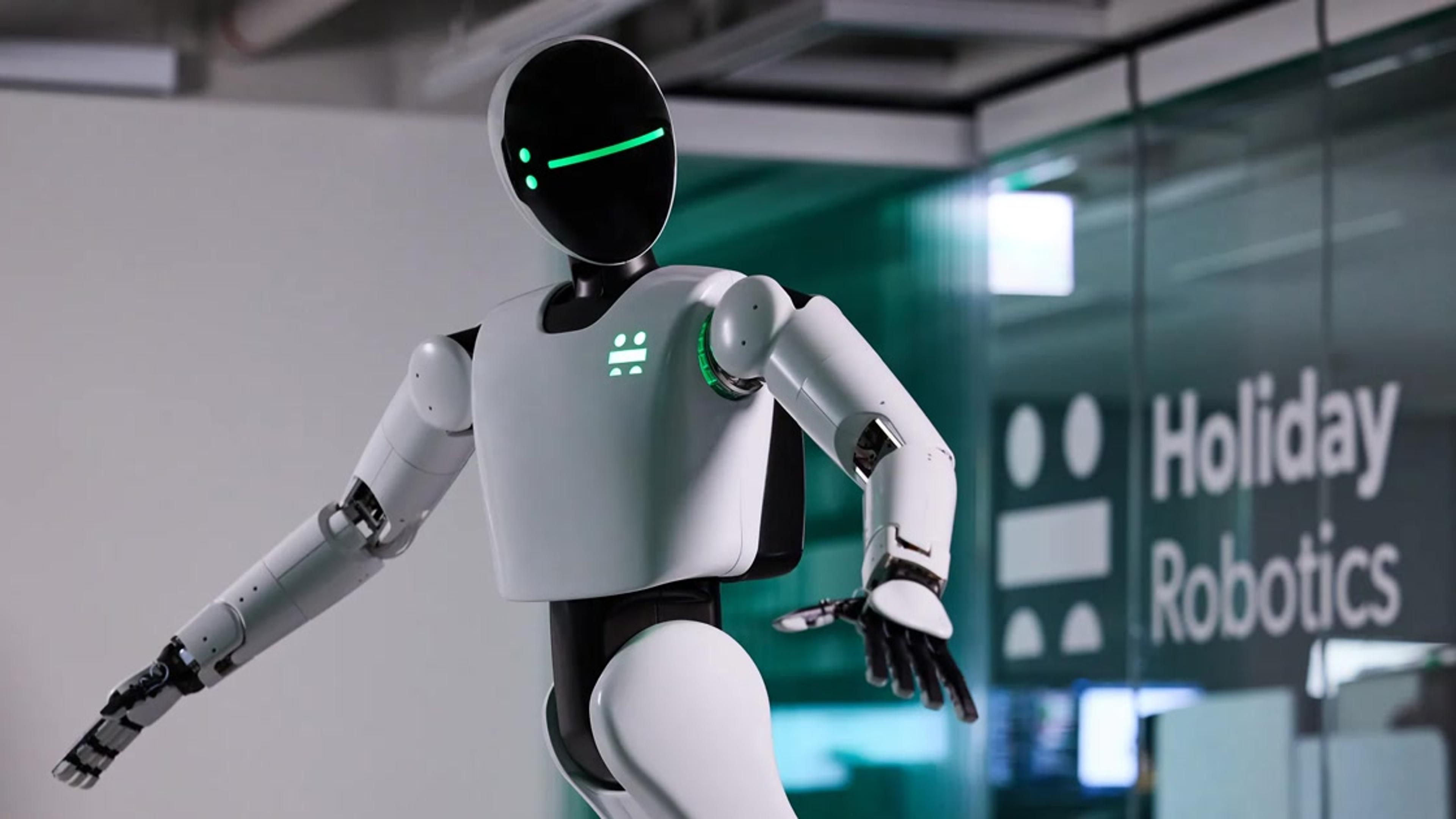
Founded in 2024, physical AI startup Holiday Robotics is developing FRIDAY, a humanoid robot designed to work alongside humans in manufacturing environments involving a lot of repetitive work.

July 17, 2026 by Nikita
Seoul, South Korea-based humanoid robot startup Holiday Robotics on Monday secured 155 billion won (roughly $105 million) in a Series A round—making it the largest funding round among domestic humanoid companies.
Holiday Robotics will deploy the funding to expand its R&D workforce and upgrade its mass-production system, building a manufacturing infrastructure to produce 10,000 units per year.
Additionally, it aims to expand its business into the service robot and home service robot market, starting with the commercialisation of humanoids for the manufacturing sector. In the short term, the startup plans to lower its product prices to about 100 million won through mass production.
Founded in 2024 by CEO Song Ki-young, physical AI startup Holiday Robotics is developing FRIDAY—a humanoid robot designed to work alongside humans in manufacturing environments involving a lot of repetitive work.
The Seoul-headquartered company aims to automate manufacturing sites using humanoid robots, drawing on its experience in manufacturing AI. It is developing FRIDAY as an affordable humanoid that can be put into real industrial sites.
“FRIDAY is built around dexterous manipulation: high-dexterity robot hands, tactile sensing across the hand, and force-aware control that lets it feel contact and adapt to it. FRIDAY has 64 degrees of freedom, 40 of which are dedicated to its hands—a direct measure of where we put our engineering focus,” the company explained in a blog.
Holiday Robotics said a wheel-based mobile base moves FRIDAY through industrial spaces, a dexterous upper body does the work, and hot-swappable batteries keep it going across a full shift.
Further, safety is designed in from the hardware up: lightweight hands with low inertia, fully back-drivable hand and arm joints, and 360° perception with multiple cameras and LiDARs to eliminate blind spots.
The startup is working with about 50 researchers, engineers, and industrial experts in robotics and AI, including those from MIT, KAIST, Seoul National University, and Samsung Electronics, who are leading product development and commercialisation.
At present, it is conducting a closed PoC (technical demonstration) with major domestic and foreign companies in industries such as automobiles, semiconductors, and logistics that involve many repetitive tasks.
Holiday Robotics aims to commercialise FRIDAY in the second half of 2026 and plans to establish a production system of 100 units per year this year. By 2027, it aims to increase its production capacity to 1,000 units to supply its humanoids throughout the manufacturing industry.
Existing investors Stone Bridge Ventures, Atinum Investments, Intervest, and Spring Camp, as well as new investors, including IMM Investment, SL Investment, KB Investment, Bon Angels Venture Partners, Premier Partners, SJ Investment Partners, Dasung Ventures, Atinum Capital Partners, Ulmus Investment, and Goodwater Capital, participated in the round.
Additionally, the Korea Development Bank and the Industrial Bank of Korea participated to lay the groundwork for securing growth funds in various ways in the future, betting on the growth potential of the humanoid robot market and Holiday Robotics’ technology, the startup said.
The Robot24.com TAKE:
When it comes to repetitive tasks, humanoids are presently most suitable for installation, manufacturing, and construction jobs. According to Barclays, manufacturing accounts for nearly 70% of all humanoid-suitable tasks. This is predominantly where many manufacturers, including Holiday Robotics, are testing their proof of concept. Companies like Figure AI (Figure 03 humanoids at BMW facility in the US) and Agility Robotics (Digit at Toyota’s Canadian manufacturing subsidiary) have already deployed their machines after successful pilot programmes.
Meanwhile, a shrinking working-age population and changing work preferences can accelerate humanoid deployment in the future. As per United Nations projections, the number of individuals aged 65 and older will rise from 0.9 billion now to 1.6 billion by 2050.
Robot24.com believes Holiday Robotics, which plans to begin commercialisation in the second half of 2026, sits at this intersection. For now, it’s a wait-and-watch game.
More articles on this topic
6 articles ReportUnitree files for Hong Kong IPO at $12B valuation
 ReportUK Robot Startup Humanoid Hits $1.35B Valuation, How Soon Till Deployment?
 ReportLimX Dynamics Raises $200 Million Ahead of Planned IPO
 ReportUnitree Gears up for IPO; NVIDIA picks the Chinese Humanoid Maker for Research Project
 ReportChinese home embodied AI startup Zeroth secures 500M yuan in pre-Series A funding
BUSINESS NEWS WEEKLY LETTER
The Weekly Letter for Robotics Professionals, Summarizing the Most Important Industry Moves, Launches, Deals and Signals.