Surgeons Use Teleoperated Humanoid Robots to Perform Live Surgery
Researchers at the University of California have successfully used two teleoperated humanoid robots to perform two surgeries during a preclinical trial.

July 9, 2026 by Carl
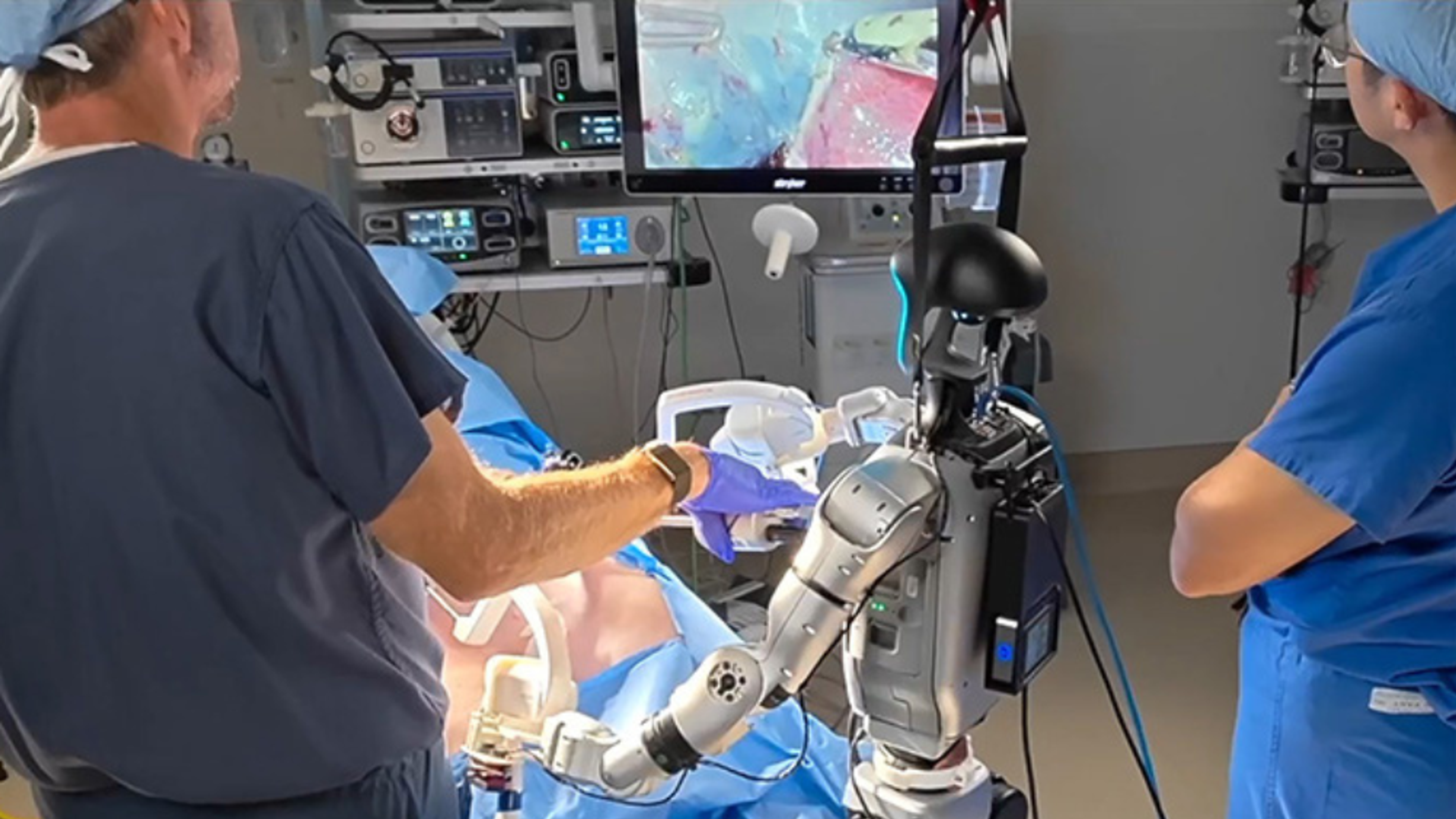
Would you trust a humanoid robot in an operating theatre? Are humanoid robots about to change the future of healthcare? Well, nowadays, scientists are all set to bring this sci-fi-sounding approach to reality. And they are actually testing humanoid robots in operating rooms.
Researchers at the University of California, San Diego, have successfully used two teleoperated humanoid robots to perform two surgeries during a preclinical trial for the first time. The findings were published in the July 8 issue of the journal Nature. And the project is the result of a collaboration between engineers and surgeons at UC.
During the trial, a human-robot surgical team successfully completed a gallbladder removal surgery. The team included a human surgeon and a robot surgeon. The surgery was performed by a robot while a human surgeon assisted during the process.
Researchers also completed a second successful operation using two humanoid robots working together as a robot-robot team. However, it is worth noting that both of these surgeries were performed on large non-primate mammals.
As per the researchers, this proof-of-concept study is definitely an important step towards bringing humanoid robots into the operating rooms. In the early stages, these robots can help human surgeons during surgeries. And later, these robots can become capable of performing surgeries while being teleoperated by experienced surgeons.
Michael Yip, a faculty member in the UC San Diego Department of Electrical and Computer Engineering and one of the paper’s senior authors, said the growing shortage of surgeons and increasing patient demand have created longer wait times and reduced access to healthcare.
“Remotely operated and autonomous humanoid robots have real potential for amplifying access to critical surgeries to which patients would otherwise not have access. This can help address the healthcare crisis not only in the United States, but also worldwide.”
Why Humanoid Robots Could Transform Surgery
Humanoid robots are not like those specialized robotic surgery systems that are designed just for a specific kind of surgery. In fact, these robots are capable of performing a variety of tasks, whether surgical or non-surgical. As per researchers, this flexibility makes these humanoid robots way more useful for remote areas as well as for places where there aren’t enough healthcare resources.
Traditional robotic surgery systems usually include three or four robotic arms, proprietary software, and specialized surgical tools. They are quite heavy and weigh around 1,800 pounds. Not only this, but they also require a large team to set up and often need specially modified operating rooms.
But that’s not the case with these robots. The robots used in this study, which are given the nickname Surgie, are 5 feet tall, and the best part is that they weigh only 60 pounds. Their small size, along with the flexibility, proves to be really handy for rural or under-resourced areas. These robots can easily be transported as well as deployed in such areas.
Researchers also found that Surgie fits in the existing operating rooms very easily. Although in order to make robots hold standard surgical instruments, there was a need to develop adapters. However, it was still way easier to operate a humanoid robot as compared to using traditional robotic surgical systems.
“We were surprised at how well Surgie meshed with our workspace and workflow,” said study co-author Nikita Thareja, MD, a general surgery resident at UC San Diego School of Medicine.
Shanglei Liu, MD, assistant professor of surgery at the UC San Diego School of Medicine and one of the paper’s senior authors, who teleoperated the robot during the trial, said the humanoid robot delivered the same level of precision as existing teleoperated surgical robotic systems.
“It’s a fraction of the cost and it takes a fraction of the space in an operating room. So it’s easy to deploy, anywhere from rural areas, to the battlefield, and even to space,” Liu said.
Challenges Still Remain
Despite the successful surgeries, researchers acknowledged that several technical challenges must still be solved. During the procedures, the robots required multiple recalibrations, making the operations significantly longer than surgeries performed with existing robotic systems.
Liu noted that this is common with emerging surgical technologies. He pointed out that the first robotic laparoscopic surgery lasted six hours, while similar procedures today can often be completed in about 30 minutes.
Another challenge is latency— a slight delay between a surgeon’s controller movements and the robot’s response. The research team is working to reduce this delay so surgeries can one day be performed over long distances for patients in remote communities.
The Future of Humanoid Robots in Operating Rooms
Beyond performing surgeries, researchers believe humanoid robots could eventually serve as autonomous surgical assistants. Because they can walk and perform many physical tasks like humans, they could fetch surgical instruments, support medical staff, and even clean operating rooms after procedures.
“One of our goals is to develop the autonomous surgical assistant,” Yip said. “Many communities struggle with adequate staffing on the surgical team, which means patients are not being treated. Our goal is an operating theatre of the future, where humanoid robots and humans work side by side as an integrated team to deliver procedures to those in need, both in traditional hospital settings as well as in non-traditional, field medicine scenarios.”
The researchers also emphasized that the project was made possible through close collaboration between engineers and surgeons, along with support from the UC San Diego Center for the Future of Surgery.
“This achievement reflects the power of bringing engineers and surgeon innovators together to solve meaningful clinical problems at our world-class training and research lab,” said Ryan Broderick, MD, interim director of the Center for the Future of Surgery and associate professor of surgery at the UC San Diego School of Medicine. “Our center provides a setting to bridge engineering innovation and clinical expertise, allowing transformative ideas to be rigorously developed, tested, and refined.”
More articles on this topic
235 articles ReportWhat it Really Costs to Own a Personal Assistant Robot at Home
 ReportA Little Company, Courtesy of a Robot
 ReportA Humanoid Walks into a New York Park
 ReportRailway Inspection Robots Search for Defects in Tracks
 ReportChina's Humanoid Supply Chain Moves Toward Industrial Production
 ReportCompanionship now comes with a Charging Cable
 ReportCould a Robotic Guide Help Blind Travelers Navigate Public Spaces?
 ReportThis Robot Finds Cracks and Fixes Them
 ReportXPENG's IRON Humanoid Adapts to Changing Human Gestures in Real Time
 ReportRobots Are Learning to Sort Clothes for Textile Recycling
 Report110 Humanoid Robots Set Guinness World Record With Synchronized Dance
 ReportScientists Teach Humanoid to Climb Ladders and Survive Falls
BUSINESS NEWS WEEKLY LETTER
The Weekly Letter for Robotics Professionals, Summarizing the Most Important Industry Moves, Launches, Deals and Signals.