The Best Humanoids for Education & Embodied-AI Development 2026
From advanced whole-body control to lower-cost teaching platforms, we compare four commercially positioned humanoids on research capability, programmability, autonomy, practical usability and ownership support.

September 29, 2026 by Business Desk Team
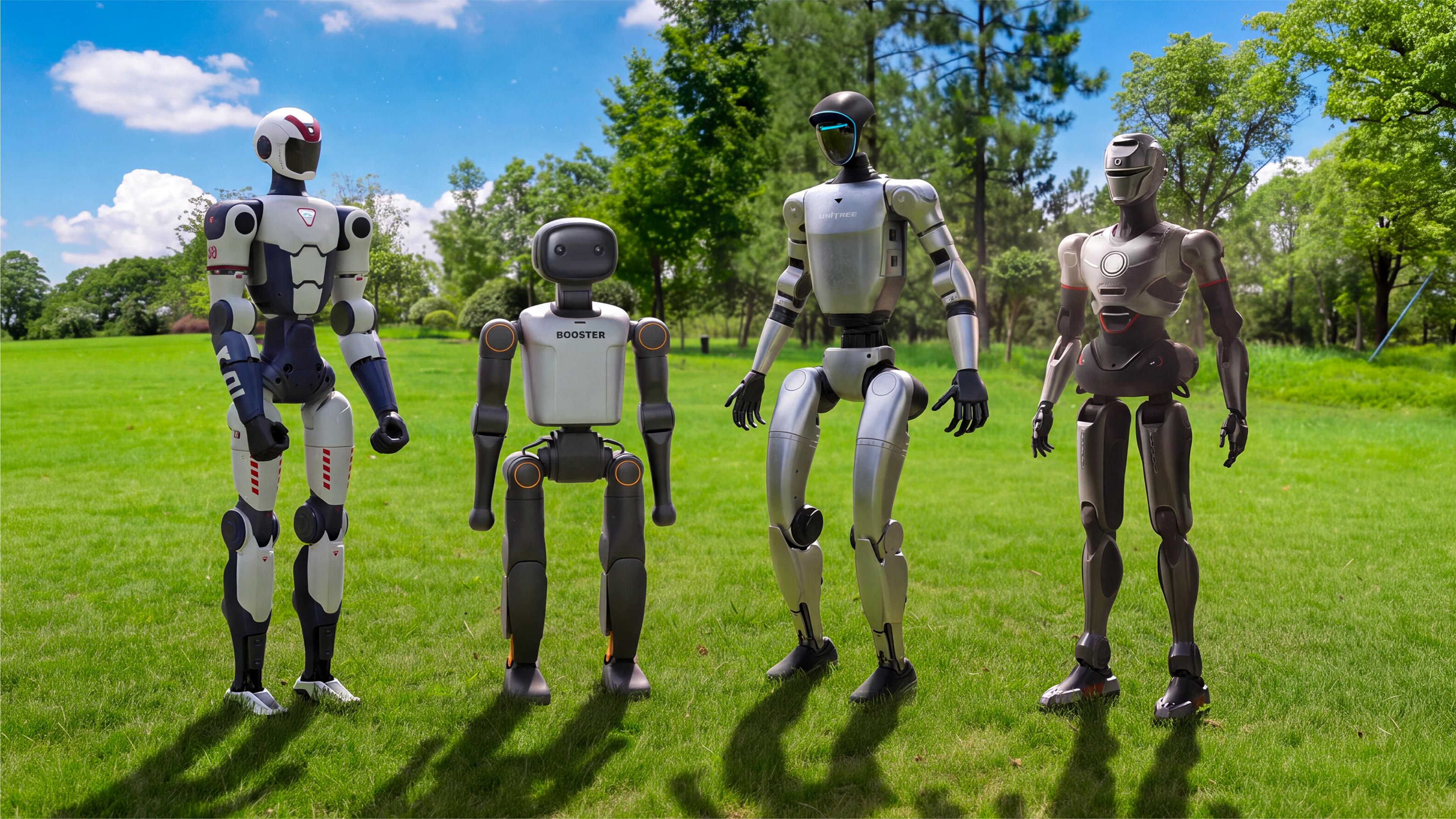
Humanoid robots are increasingly being used by universities, robotics laboratories and AI teams to study locomotion, whole-body control, reinforcement learning and human-scale manipulation. Their usefulness as development platforms depends not only on hardware performance, but also on how much access researchers get to software, sensors, joints and simulation tools.
This ranking compares Unitree’s G1 EDU and R1 EDU, EngineAI’s PM01 Education Edition and Booster Robotics’ K1. The four platforms overlap in education and embodied-AI development, but differ substantially in manipulation capability, compute, runtime, developer access and price.
We assess each model using Robot24.com’s Market Research Database across five equally weighted areas: capability for the intended task; programmability and development tools; autonomy, reliability and safety; runtime and practical usability; and ownership cost and support. The ranking reflects the documented data available in the source review. The methodology appears below.
At a Glance
The order below follows the overall ranking in the source assessment; no numerical overall scores were provided, so none have been added.
| Rank | Robot | Standout specification | Best suited to |
|---|---|---|---|
| 1 | Unitree G1 EDU | Up to 43 DOF; optional Jetson Orin up to 100 TOPS | Advanced embodied-AI, locomotion and manipulation research |
| 2 | EngineAI PM01 Education Edition | 24 DOF; approx. US$12,000–13,700 recorded price | Capable university and AI research at lower capital cost |
| 3 | Booster K1 | ROS/ROS 2, simulation and reinforcement-learning support | Locomotion, RL and whole-body control research |
| 4 | Unitree R1 EDU | Approx. 26–40 DOF; R1 family starts around US$5,900 | Teaching labs, student projects and multi-robot setups |
The Robots Behind the Rankings
1. Unitree G1 EDU: Best overall for advanced embodied-AI development
Overall Score 88/100
Unitree G1 EDU takes first place for the strongest documented combination of locomotion capability, whole-body control, developer access and manipulation potential. The source data records 23 degrees of freedom, expandable to as many as 43 depending on the EDU configuration, alongside autonomous walking, running, stair climbing, dynamic balancing and coordinated whole-body motion.
Its research appeal is strengthened by dual-arm manipulation, precision grasping, tool handling and force-controlled manipulation, with optional three- or five-finger dexterous hands. Development support includes ROS 2, SDK access, Python and C++ APIs, secondary development, reinforcement learning and imitation learning. Optional NVIDIA Jetson Orin compute is listed at up to 100 TOPS, while runtime is approximately two hours from a 9,000 mAh quick-release battery.
The main trade-off is cost. The recorded price starts at US$43,900 depending on configuration, and the source review does not record warranty or manufacturing lead time. It is best suited to universities, advanced robotics laboratories and embodied-AI teams that want one platform spanning locomotion, manipulation and AI research.
2. EngineAI PM01 Education Edition: Strong performance-to-cost research platform
Overall Score: 84/100
EngineAI PM01 Education Edition ranks second by combining capable humanoid hardware, compute and runtime with a substantially lower recorded price than G1 EDU. The source data records 24 degrees of freedom, walking, running, dynamic balance, terrain adaptation and autonomous navigation, along with a 15 kg payload capacity.
The platform is recorded with Intel N97 and NVIDIA Jetson Orin compute, plus ROS/ROS 2, SDK/API support and open-source development. Runtime is approximately two hours with a quick-swap battery. Its recorded price of approximately US$12,000–13,700 gives it a notably lower entry point than the G1 EDU in the reviewed data.
Its limitation is documentation depth: the source contains less detailed evidence for dexterous manipulation, granular developer interfaces and supporting tools than it does for G1 EDU. It is best suited to universities and AI or robotics labs seeking capable humanoid hardware at a lower capital cost.
3. Booster K1: Very good developer and locomotion research platform
Overall Score: 80/100
Booster K1 places third with a platform strongly oriented toward research, education, reinforcement learning and humanoid development. Depending on configuration, the source records approximately 23–29 degrees of freedom, dynamic balance, autonomous navigation, running, whole-body motion planning, fall detection and partial recovery control.
Its developer stack is a major strength. K1 is recorded with ROS and ROS 2, SDK access, simulation integration, digital-twin support and reinforcement-learning support. Dual arms can be paired with optional multi-finger hands or grippers for pick-and-place and research manipulation. Runtime is approximately one to two hours with a swappable lithium battery.
The source records a typical one-year warranty, extended support and an approximate lead time of four to 12 weeks, but also a relatively broad US$25,000–50,000 price range. Its main trade-off is comparatively high cost and more limited dexterous manipulation than a suitably configured G1 EDU. It is best suited to locomotion, reinforcement-learning and whole-body humanoid-control research.
4. Unitree R1 EDU: Best low-cost entry into humanoid development
Overall Score: 76/100
Unitree R1 EDU completes the ranking as an accessible education and development platform for teams that prioritise teaching, experimentation and lower entry cost over maximum runtime or the broadest advanced feature set. The EDU configuration is recorded at approximately 26–40 degrees of freedom, with autonomous bipedal walking, dynamic balancing and terrain adaptation.
The source also records optional dexterous hands and optional NVIDIA Jetson Orin compute, alongside secondary development, simulation-platform support, open joint interfaces and open sensor interfaces. Runtime is approximately one hour from a quick-release battery, the shortest recorded endurance in this comparison.
R1 family pricing starts around US$5,900, although the exact R1 EDU price is listed as Contact Vendor. A 12-month warranty is recorded. Compared with G1 EDU, the source contains less evidence of advanced manipulation and whole-body experimental capability, but R1 EDU remains particularly relevant to teaching laboratories, university courses, student projects and teams that want multiple humanoid platforms on a tighter budget.
The best fit depends on the research programme
Unitree G1 EDU leads the source assessment through its combination of advanced locomotion, manipulation potential and broad developer access. Teams seeking a lower-cost but still capable research platform may place greater value on EngineAI PM01 Education Edition, while Booster K1 is particularly oriented toward locomotion, reinforcement learning and whole-body control. Unitree R1 EDU offers the most accessible route in this group for teaching and lower-cost experimentation.
The final choice depends on whether the programme prioritises manipulation, locomotion, software openness, runtime, fleet scale or acquisition cost. Configuration also matters: several of these platforms offer optional compute, hands or expanded degrees of freedom, so equivalent configurations should be compared before purchase.
RANKING EXPLAINED
The source assessment treats all five criteria as equally weighted. It uses the documented Robot24.com Market Research Database record and avoids assigning edition-specific capabilities that are not supported by the available data. Where exact pricing or support information is missing, that limitation is retained rather than filled with assumptions.
| Parameter | What we assess | Weight |
|---|---|---|
| Capability for the intended task | Locomotion and whole-body control experiments; manipulation capability where applicable. | 20% |
| Programmability and development tools | SDK/API access, joint and sensor control, documentation, simulation, ROS compatibility and recorded-data access. | 20% |
| Autonomy, reliability and safety | Autonomous operation, repeatability, intervention needs, error recovery and documented safety controls. | 20% |
| Runtime and practical usability | Runtime, charging or battery replacement, setup effort, calibration and maintenance. | 20% |
| Ownership cost and support | Equivalent configuration price, required accessories/software, warranty, spare parts, training and technical support. | 20% |
Each criterion receives a score out of 10, converted into a weighted total out of 100. Equivalent configurations are compared where possible, and included features are distinguished from optional extras. Where public evidence is limited, that gap is reflected in the relevant criterion rather than filled with assumptions.

BUSINESS NEWS WEEKLY LETTER
The Weekly Letter for Robotics Professionals, Summarizing the Most Important Industry Moves, Launches, Deals and Signals.