The Best Restaurant Service Robots on the Market
From carrying meals to returning dishes, we compare five restaurant service robots on task capability, navigation, battery life, workflow integration and deployment evidence.

September 22, 2026 by Business Desk Team
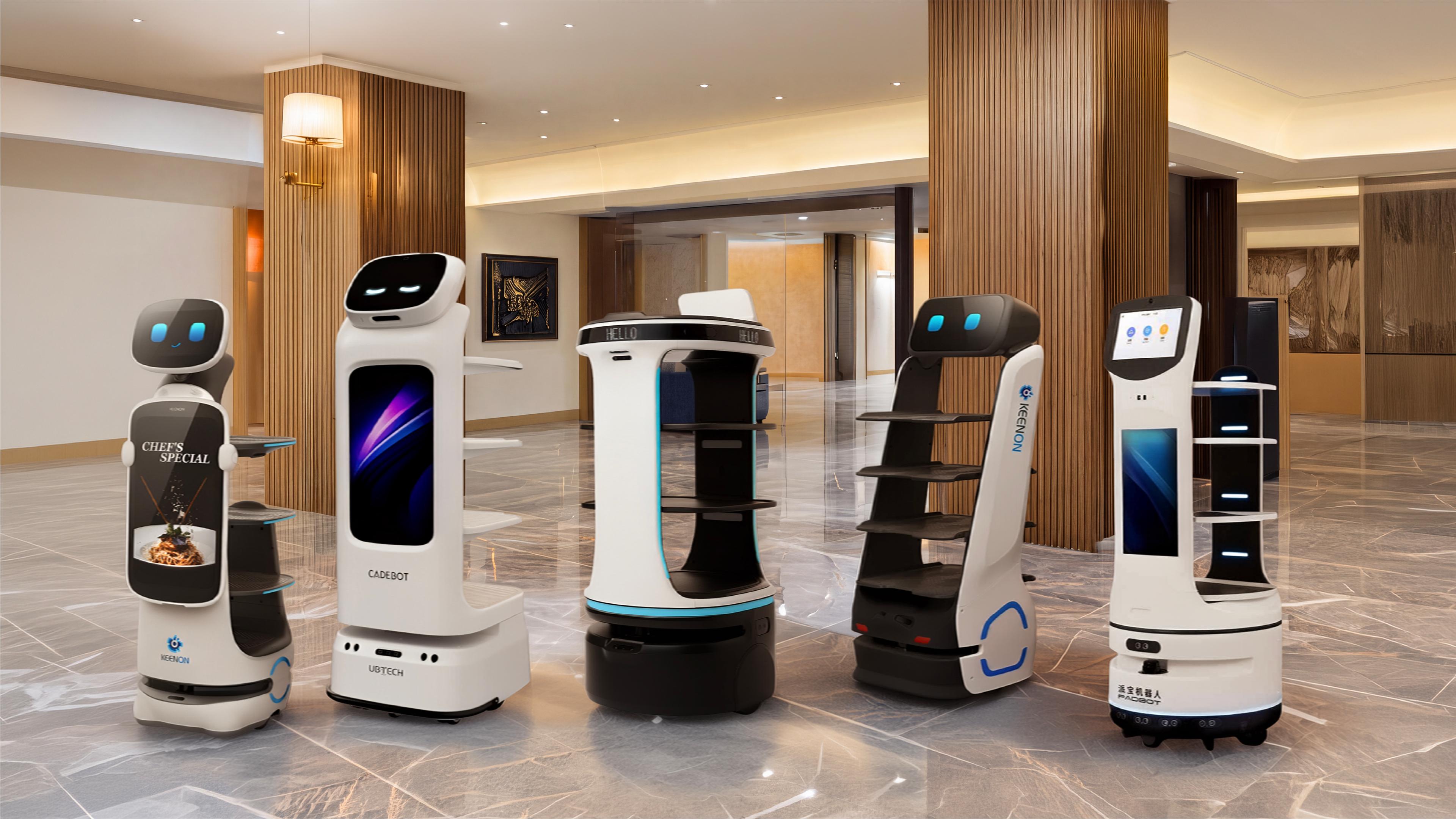
Introduction
Restaurant service robots help staff transport meals, drinks and used dishes. Their usefulness depends on how well they fit a venue’s layout, service volume and daily routines.
This ranking compares Bear Robotics’ Servi Plus, KEENON’s DINERBOT T9 Pro and DINERBOT T10, UBTECH’s CADEBOT L100 and PadBot’s W3s.
We assess each model against five criteria using Robot24.com’s Market Research Database: restaurant task capability, autonomy and navigation, runtime and charging, restaurant workflow integration, and deployment evidence and support.
The ranking below reflects documented specifications and deployment evidence. Details of the methodology are at the end of the article.
AT A GLANCE
| Rank | Robot | Overall score | Standout specification | Best suited to |
|---|---|---|---|---|
| 1 | KEENON DINERBOT T10 | 97/100 | 40 kg payload and 59 cm minimum passage width | Busy restaurants with narrow aisles |
| 2 | KEENON DINERBOT T9 Pro | 96/100 | Up to 15 hours of runtime | Long shifts and high-volume service |
| 3 | Bear Robotics Servi Plus | 90/100 | Carries 40 kg or more than 16 entrées | High-volume food and dish transport |
| 4 | UBTECH CADEBOT L100 | 87/100 | 40 kg across four trays | Multi-destination restaurant delivery |
| 5 | PadBot W3s | 80/100 | Four levels and 40 kg capacity | Meal delivery and plate-return workflows |
The Robots Behind the Rankings
1. KEENON DINERBOT T10: Best for narrow restaurant spaces
Overall score: 97/100
The DINERBOT T10 takes first place by combining high carrying capacity with the strongest narrow-space navigation in this comparison. Its 40 kg total payload is spread across four trays, while a minimum passage width of 59 cm gives it an advantage in restaurants where tables and chairs leave limited room for robots to move.
Its navigation system combines LiDAR, VSLAM, stereo vision and dynamic route planning. For restaurant staff, that means a robot designed to manoeuvre around obstacles while carrying meals or collecting dishes. KEENON also equips the T10 for multi-table delivery, tray detection and self-pickup assistance.
Restaurant workflow features include cloud fleet management, remote management, route optimisation and support for fleets of up to 20 robots. Battery life is listed at 9–12.5 hours in Robot24’s database, with automatic charging supported.
KEENON’s wider support network strengthens the T10’s position, with installation, technical support, maintenance, spare parts and warranty services recorded in the database. Its main trade-off is charging: the documented 4–5.5-hour charging window is longer than some rivals.
2. KEENON DINERBOT T9 Pro: Built for long shifts
Overall score: 96/100
For restaurants that need a robot to stay on the floor for long periods, the DINERBOT T9 Pro makes a strong case. Its standout specification is up to 15 hours of runtime — the longest documented maximum among the five robots in this comparison.
Like the T10, it can carry 40 kg across four trays. It supports food delivery and dish return, while plate detection and tray-occupancy sensing help the robot keep track of its load. Intelligent task dispatch, cloud fleet management and support for up to 20 robots add to its usefulness in larger operations.
The T9 Pro uses markerless VSLAM, LiDAR SLAM, stereo vision and 3D perception for autonomous navigation and obstacle avoidance. Automatic charging is supported, with a charging time of around four hours.
What keeps it just behind the T10 is manoeuvrability. Its documented minimum passage width is 70 cm, compared with the T10’s 59 cm. That difference could matter in tightly packed dining rooms. Some partner information in Robot24’s database is also flagged for further verification.
3. Bear Robotics Servi Plus: Made for high-volume carrying
Overall score: 90/100
Servi Plus stands out for moving a lot of food in a single trip. Bear Robotics says the robot can carry more than 16 entrées at once, with a total payload of 40 kg and space for two to four configurable trays or up to four standard bus tubs.
That flexibility makes it particularly useful for both sides of restaurant service: taking meals out and bringing used dishes back. Active suspension is another practical advantage, helping stabilise food and drinks as the robot crosses different flooring, ramps and small thresholds.
Servi Plus has a documented minimum passage width of 65 cm and can reroute when it encounters obstacles. Its multi-robot orchestration system allows several units to operate together while reducing congestion between robots.
Battery life is listed at 10–12 hours, with automatic charging available. Bear Robotics also documents installation, mapping, workflow integration and technical support for customers.
Servi Plus loses some ground to the KEENON models because its recorded workflow feature set is less extensive in areas such as tray sensing and task dispatch. But for restaurants prioritising carrying capacity and straightforward food-and-dish transport, it remains a strong option.
4. UBTECH CADEBOT L100: Strong multi-destination delivery
Overall score: 87/100
CADEBOT L100 offers a 40 kg payload across four trays and is designed for food and beverage delivery as well as dish collection. Its ability to handle multiple orders and destinations makes it particularly relevant to restaurants that want one robot to serve several points during a run.
The robot uses laser SLAM, sensor fusion, RGB and depth cameras, along with ultrasonic, cliff and collision sensors. A documented minimum passage width of 650 mm keeps it competitive in relatively constrained restaurant environments.
Its workflow features include cloud and mobile management, remote monitoring, fleet management and multi-robot deployment. The robot also provides voice interaction and an advertising display, giving restaurants an additional customer-facing function.
UBTECH records extensive support infrastructure, including on-site and remote assistance, spare-parts stock, more than 50 support engineers and a response SLA of under 24 hours. That gives CADEBOT L100 the strongest support score in this comparison.
Its main limitation is runtime. At up to eight hours, it falls behind the longer-running KEENON and Bear Robotics models, which weighs on its overall score.
5. PadBot W3s: A practical food-and-plate runner
Overall score: 80/100
Completing the ranking, PadBot W3s combines restaurant delivery with a dedicated plate-return mode. It carries up to 40 kg across four illuminated levels and supports multi-point delivery, making it suitable for moving meals out and used dishes back.
Its navigation system combines LiDAR, matrix radar and LDS SLAM with real-time obstacle avoidance and route planning. The robot can also store up to 100 maps, giving it flexibility across mapped indoor environments.
PadBot includes intelligent task scheduling, real-time delivery tracking, remote control, voice announcements and automatic low-battery charging. Runtime is around 10 hours, which is competitive with several models in this ranking.
The biggest drawback is charging time. At six to eight hours, W3s takes considerably longer to recharge than the other robots assessed here. Robot24’s database also contains less detailed deployment and support evidence for PadBot than for KEENON or UBTECH.
Its fifth-place finish therefore reflects both a charging disadvantage and a thinner body of documented commercial support evidence rather than a lack of core restaurant-delivery capability.
The best fit depends on the dining room
The DINERBOT T10 leads this assessment through a combination of 40 kg carrying capacity, narrow-space navigation and restaurant workflow features. Its 59 cm minimum passage width gives it a particular advantage where floor space is tight.
But the highest overall score does not settle every restaurant’s choice. Venues running particularly long shifts may place more value on the T9 Pro’s maximum 15-hour runtime, while high-volume operations could benefit from Servi Plus and its capacity for more than 16 entrées or four bus tubs. CADEBOT L100 stands out for documented manufacturer support, while PadBot W3s combines meal delivery with a dedicated plate-return mode.
The practical choice therefore depends on what a restaurant needs the robot to do most: navigate crowded aisles, work longer hours, move larger loads, coordinate deliveries or return dishes.
RANKING EXPLAINED
| Parameter | What we assess | Weight |
|---|---|---|
| Restaurant task capability | Payload, usable tray space, meal delivery and dish-return functions | 30% |
| Autonomy and navigation | Minimum passage width, obstacle avoidance and route planning | 25% |
| Runtime and charging | Runtime under stated conditions, charging time and automatic docking | 15% |
| Restaurant workflow integration | Staff controls, multi-table delivery, tray detection, scheduling and fleet coordination | 15% |
| Deployment evidence and support | Commercial availability, documented deployments and manufacturer support | 15% |
Each robot receives a score out of 10 for the five criteria, which is converted into a weighted total out of 100. Only capabilities documented in Robot24.com’s Market Research Database are credited.
Missing specifications are not treated as proof that a robot lacks a feature. Instead, incomplete documentation is recorded as an evidence gap and factored into the relevant category. Optional features are credited only where they are clearly identified and documented.
Battery figures are manufacturer-stated and can vary with operating conditions, workload and settings. Deployment and support scores consider the evidence available for each manufacturer and model rather than assuming equivalent support across all markets.

BUSINESS NEWS WEEKLY LETTER
The Weekly Letter for Robotics Professionals, Summarizing the Most Important Industry Moves, Launches, Deals and Signals.